
Music for the Festival of the Christian Home (Mother's Day)

Mother's Day, though not a sacred holiday, is often observed in some way in churches of various denominations.
The day actually originated in a Methodist Episcopal Church in Grafton, West Virginia in May 1907, when Anna Jarvis, organized a special service to honor her late mother.
The next year, Anna advocated that the second Sunday in May be a day to honor all mothers. Mother’s Day became an official holiday in 1912.
Despite its good intentions, know that this can be a difficult day and that some within each congregation may struggle with the celebration (or avoid church altogether that day).
The person who lost their mother at a young age.
The mother who lost a child.
The person who was abandoned by their mother.
The woman who longs to be a mother, but isn’t.
The woman who longs to be a mother, but can’t.
The woman who has chosen not to have children.
The person who has a difficult relationship with their mother.
Acknowledging this, some churches have taken to broadening the traditional Mother’s Day celebration to include families and all who nurture and care for others (men and women alike).
The United Methodist denomination calls this the "Festival of the Christian Home"—a day to celebrate the gift of home and those who share it with us, in our immediate families, our communities, and within the church itself.
Planning a Festival of the Christian Home at your church this spring? Here are a few resources and music suggestions to help get you started:
Music for the Festival of the Christian Home
*Disclosure: I get commissions for purchases made through links in this post.
Hymns
Leaning On the Everlasting Arms
We, Thy People, Praise Thee
Christian People, Raise Your Song
Now Thank We All Our God
Our Parent, By Whose Name
Happy the Home When God Is There
O Lord, May Church and Home Combine
Blest Be the Tie That Binds
Come, Christians, Join to Sing
Help Us Accept Each Other
Love Divine, All Loves Excelling
Be Thou My Vision
Christ is Made the Sure Foundation
The Church's One Foundation
O Church of God, United
Father, We Thank You
We Are God's People
All People That On Earth Do Dwell
For the Beauty of the Earth
Your Love, O God, Has Called Us Here
O How He Loves You and Me
How Can We Name a Love
Lord of All Hopefulness
Sent Forth By God's Blessing
Joyful, Joyful
Sing With All the Saints in Glory
O Sons and Daughters, Let Us Sing
Children's Choir Anthems
Having your children’s choir sing on Mother’s Day is a natural choice. Here are a few anthems that work well for the Festival of the Christian Home service:
“Thank You God for Family” (Joseph Martin) from Sing and Celebrate 5!
Unison Choir with Piano
A sweet song that gives thanks for families, incorporating the familiar children’s hymn, “God Is So Good."
The Gift of Home (Ruth Elaine Schram & Aren Newell Williams)
Unison/2-part Choir with Piano
A sung reflection on the gift of home, love, and family.
The Gift of Love (arr. Hal Hopson)
Unison Choir with Piano
This familiar and well-known anthem features text from 1 Corinthians 13.
“God, Bless Our Family” (Jeff Reeves & Ruth Elaine Schram) from Sing and Celebrate 6!
Unison Choir with Piano
A heartfelt prayer of blessing for families, with rich, meaningful text.
A Family Song (Joseph Martin/arr. Brad Nix)
Unison/2-part Choir with Piano
A song of thanks for parents, brothers, sisters, and “dear ones, near and far,” and a beautiful affirmation that families come in all shapes and sizes.
You Are the Hands (Lynn Shaw Bailey/arr. Becki Slagle Mayo)
Unison/2-part Choir with Piano
A touching anthem that honors those who care for, nurture, and invest in the lives of children.
God Bless Families (Natalie Sleeth)
Unison Choir with Piano
A sweet, simple song of blessing for “families near and far” with melodic repetition and contrasting sections.
“Love Is…” (Jeff Reeves) from Sing and Celebrate 8!
Unison Choir with Piano
An anthem about what love is, with text based on 1 Corinthians 13.
God, Bless My Family (Cindy Berry)
Unison/2-part Choir with Piano
This beautiful, prayerful anthem incorporates a few lines from the hymn “For the Beauty of the Earth.”
Mother’s Day Specific Anthems
“A Mother’s Day Prayer” (Patti Drennan) from Sing and Celebrate 3!
Unison Choir with Piano
A Mother’s Love (Mark Patterson)
Unison Choir with Piano and opt. Cello or C Instrument
Worship Resources
Blessing of the Families Liturgy (Mandy McDow)
Mother’s Day Resources (Steve Garnaas-Holmes)
I’d love to hear from you:
How do you celebrate Mother’s Day and the Festival of the Christian Home in your church?
If you're like me, you first learned solfege from Julie Andrews in The Sound of Music. This 1965 classic is still beloved today—it's a favorite among my elementary piano students!
Solfege is a useful tool for developing sight-singing and music-reading skills. It’s beneficial for teaching ear-training, harmonic function, and tonal relationships. It also promotes good vowels when singing, as each solfege syllable is a pure vowel sound.
Call and response is a form of musical dialogue: Someone sings or plays a musical phrase, and someone else (or a group of people) responds, either echoing the phrase back or providing a musical answer.
Call and response stems from a variety of musical traditions, including African, Cuban, folk, and early church music (think cantor and congregation). (source)
Call and response can be a useful teaching tool, as it gives young children an opportunity to listen, imitate, explore the voice, and gain confidence in their singing.

From August or September until May or June, choir and ensemble members of all ages gather in communities across the country week after week. They sing, they smile, they learn, but most of all, they give their time to be part of something bigger than themselves.
It’s a commitment, and often one that includes the whole family. This alone is something worth acknowledging and celebrating.
But then there’s the wonderful work that you do together throughout the year—the music you learn, the songs you sing, the services and programs and concerts you present, the community you build.
Here are five ways to celebrate the end of another wonderful year and show your appreciation for your choir and ensemble members this spring.

Have you ever thought about how you give praise and offer encouraging words in your teaching? Is there a way to do this that promotes learning?
How can you use your words to foster the development of intrinsic motivation and a positive self-image in your students?

Rhythm pattern cards are a great way to teach new rhythmic concepts, reinforce familiar patterns, and build that all-important music vocabulary (the ability to understand and create your own musical patterns and sequences).
There are lots of different types of rhythm pattern cards out there - some you can buy, some you can download and print for free (like the set I'm sharing below!), and ideas for making some of your own.
They don’t have to be fancy! The ones I'm sharing today can be printed at home on white cardstock and cut into quarters (postcard-size).

Are you looking for books you can sing or chant in your elementary music classes, group classes in your studio, or children’s choir rehearsals?
You know the ones: books that either have lyrics to a familiar children’s song or hymn, or stories with text that can be sung to a familiar tune, like “Twinkle, Twinkle, Little Star.”
Music publishers often present reading sessions at conferences, clinics, and professional development workshops. Clinicians sometimes curate their own reading sessions with some of their favorite works, too. If you’re a director, this is a good way to learn about new repertoire and choose music for the year ahead.
In this post, you’ll find a list of reading session picks I’ve curated through the years for elementary (K-6) choirs. Some feature opportunities to introduce part-singing and include other instruments: organ, flute, handbells or handchimes, and rhythm instruments. This is a great way to develop musical independence in your singers and help foster their listening skills.

Singing is a full-body activity (source). And we know that movement is a valuable tool for helping children understand and engage with music.
This is why so many children’s choir directors and elementary music teachers teach songs and anthems with hand, arm, or body movement of some kind.
Sign language is a natural choice.
Fall is here, which means the return of Georgia football (Go Dawgs!), puffer vests, and apple everything (sorry, PSL).
It also means lots of repertoire planning and rehearsing for Christmas programs, musicals, and holiday concerts.
I recognize that some of you are in positions where you may be programming a holiday concert or program, whether that's a school or community setting or an interfaith musical celebration with area churches. If you're looking for choral music that touches on various Winter holidays and celebrations, I hope the list of anthems below is helpful to you.

Each year, I spend some time looking through the new choral releases: studying the scores and listening to recordings. Then, I curate my favorites for you here on the blog.
Today, I’m sharing six new anthem releases for unison/opt. 2-part choirs—several with optional instrumental parts, which creates opportunities to include other musicians, perhaps from your congregation. I’ll also tell you about a brand-new graded curriculum option for Fall 2022 (for those of you looking for a comprehensive, all-in-one resource) with a theme that really resonates in our world today.
I hope you find something you love for your children’s choir this year!
Part-singing is one of the great joys of choral singing.
The challenge of singing an independent line and that satisfying feeling of creating harmony and musical interest is both fun and motivating for singers (of all ages!).
But how do you teach that?

Do you teach a preschool choir?
If so, you know that preschoolers are musical explorers. They love to sing, dance, play, move, and experience music with their whole selves.

It’s normal to feel a little burnt out after the year we’ve just had. It’s normal to feel tired or frustrated or lost. But what have you learned? What strategies will you keep? How have the events of the last year changed us as teachers, as musicians? What will we do differently going forward?
Games and musical activities are a fun and engaging way to introduce and reinforce new musical concepts and develop musical skills like listening, singing, expression, coordination, and internalizing a sense of steady beat.
Today, I'm sharing a few of my favorite musical games and activities for elementary music classes, children's choirs, and elementary group classes.

Today, I’m sharing a collection of children’s choir anthems composed by women.
After all, March is Women’s History Month and over the years, it’s also become a time to celebrate women in music.
If you’re looking for some inspiration for your planning this year and seeking ways to include more diversity in the voices you share and represent, here are 36 children’s choir anthems written by women composers to help you get started.

Advent looks a little different this year, doesn’t it?
In the midst of a global pandemic, we know what it feels like to be a people walking in darkness, waiting for the light. We know what it feels like to hope for something and long for peace in the world.
This year, Advent takes on new meaning for us. But that doesn’t mean we have less to celebrate.
Whether you're gathering via Zoom or in person (6' apart), here's a fresh, creative resource you can use with your children's choir this season.

Several years ago, I put together a list of my Top 50 Favorite Anthems for Children’s Choir.
But there are so many wonderful anthems out there for children’s voices, who can stop at 50?!
You know I can’t.
So today, I’m sharing the sequel you’ve all been waiting for: 50 more favorite anthems for children’s choir.
This list includes mostly unison and two-part music, with a few 3-part pieces for those of you with older elementary choirs and/or larger groups.

This year has brought some unprecedented challenges and the global pandemic has changed the way choirs and musical ensembles gather and make music together. Many choirs moved to online rehearsals this spring, using Zoom or Facebook Live to stay connected and try to continue making music the best they could. But with the technology we have available to us and unpredictable internet speeds at home, we’ve all learned that it’s really not possible to sing or play together in real-time.
Today, I’m sharing some helpful digital tools and resources that can be used in online choir rehearsals (synchronous or asynchronous) or in-person, if and when you’re able to return to that. You’ll find digital tools, game ideas, teaching strategies, and curriculum resources that were designed especially for distance-learning situations.

Last week, I shared the first post in a new series I’m putting together this summer: Music by Black Composers: 105 Sacred Works for Organ.
As I mentioned in that post, I believe it’s important to listen and learn from the African-American and Black community during this time, to ask ourselves: Are we honoring all the voices that have contributed to our field? Are we celebrating the diversity of composers in addition to diversity in styles?
If you work with a children’s choir or youth choir or are looking for a few simple pieces by Black composers to introduce to your adult choir in the future, here’s a list of anthems to get you started.

These are strange times we’re living in.
Who would have thought that we’d find ourselves worshipping through a screen — together, but apart, that congregations would scatter, events would be canceled, and choirs would not be able to sing?
And yet, for the safety of our friends and neighbors and community members, here we are. Each in our own homes, flattening the COVID-19 curve, but missing the connection, the fellowship, the joy that comes with making music together.
I’ve been thinking about creative ways you can connect (and sing!) with your choir virtually and today, I’m sharing a round-up of 19 ideas (for adult choirs and children’s choirs) that you can start using right away.

If you walk into an elementary classroom, you might notice that everything is color-coded: signs and charts on the wall to labels on bins to pieces of tape marking certain spots on the floor.
This is because colors are easy for most young children to recognize and differentiate between.
But in music, our baseline is black and white, the colors of standard notation. When first introducing music-reading, it can be challenging for young students to recognize patterns and organize the content visually when everything is black and white.
For this reason, color can be a helpful tool when teaching music literacy and developing music-reading skills. “When we use color in a systematic way it can help students retain information better than just using black and white.” (source)

In the book, How We Learn: The Surprising Truth About When, Where, and How It Happens, Benedict Carey stated, “Games are the best learning tool.”
It’s true, isn’t it? Games often have a way of teaching us something new without us realizing we are learning. We’re concentrating on the rules, listening, observing, interacting, and in the end, playing.
Learning is simply embedded in the process.

Do you remember those songs we used to sing as kids that went on and on and on? That had what felt like a hundred verses, each one longer and sillier than the one before it?
This is the joy of a cumulative song.
From music class to road trips, playgrounds to choir rehearsal, cumulative songs are fun to sing, engaging for children of all ages, and an effective teaching tool.
For those of you who may not know what I’m talking about, a cumulative song is a song that adds a new phrase of text with each repetition.
Usually, the lyrics are a list of some kind, getting progressively longer as the song goes on.

It’s the most wonderful time of the year - back-to-school season, that is!
Even though I’m not a student anymore, as a teacher, I love the fresh-start feeling that comes with a new academic year (including new school supplies!).
And the same is true in church settings when choir and ensembles start back up.
But getting back into that weekly rehearsal routine after a long summer hiatus can be challenging, and making sure you’re prepared and ready for that first week back can be a daunting task, particularly if you procrastinated on some of those things on your summer to-do list:

How do you plan your choir year?
Maybe you spend some time over the summer mapping out what dates your choir will sing, what hymns you’d like to teach them, listening to new releases from the publishers to get ideas for anthems, and searching Pinterest for games and other creative ideas.
Maybe you plan the first few weeks of rehearsals and then get burnt out and start winging it.
Maybe you’re somewhere in between.
As Winston Churchill once said, “Plans are of little importance, but planning is essential.”
We need to plan ahead in order to teach effectively. We need to think about the musical growth and learning we’d like to see and make a plan for how to get there.
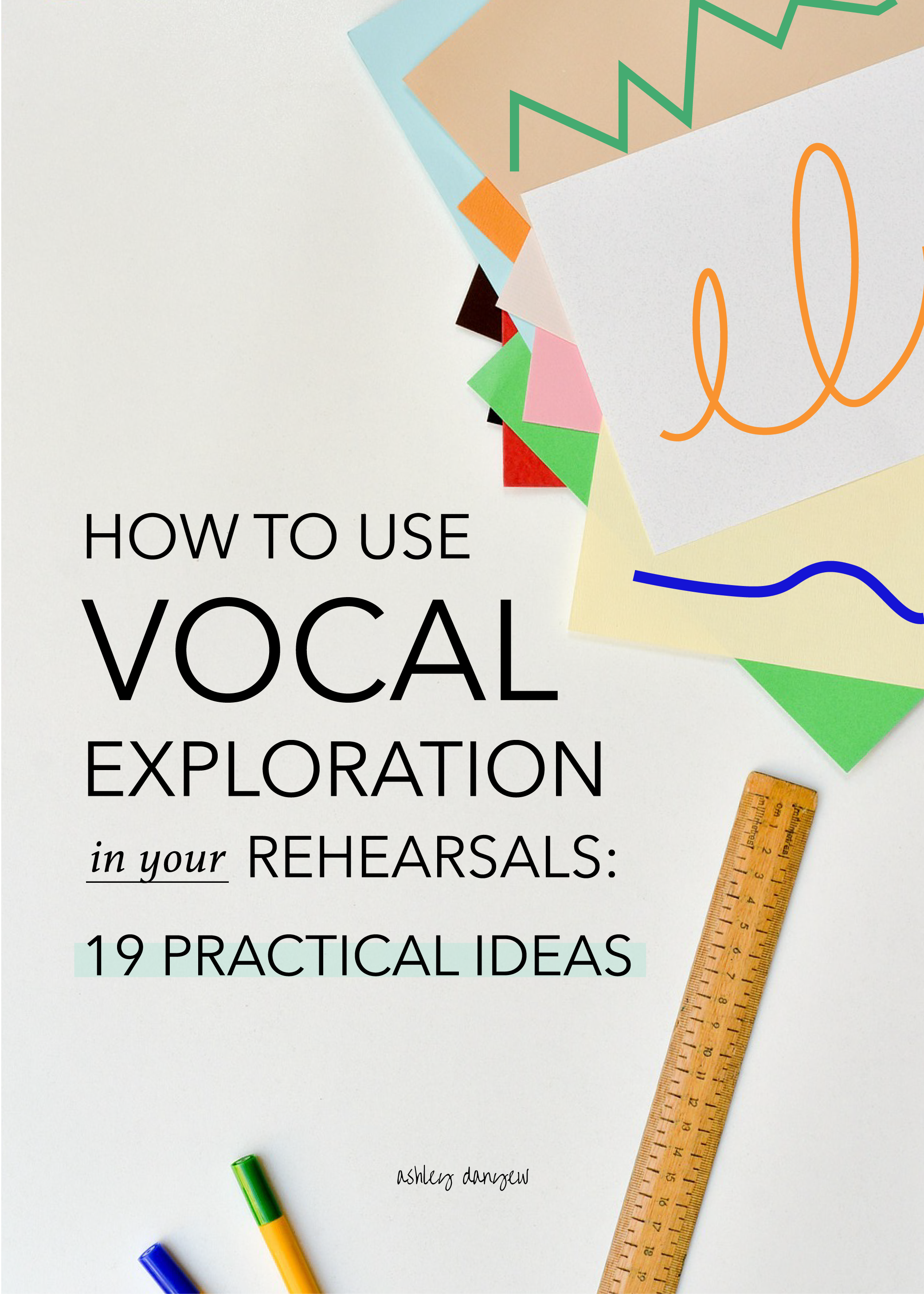
Vocal exploration, or time spent exploring what the voice can do is a vital part of early childhood and elementary music-making. Invite your singers to experience what their voice can do and experiment with different types of sounds.
As you plan your choir rehearsals, look for new and creative ways for children to explore what their voices can do.
Spend a few minutes each week reviewing the four voices: speaking, singing, whispering, shouting. Then, take some time to create vocal sound effects that span the entire vocal range. This helps them build coordination and develop control of their voice, learn about their voice and what it means to sing, and build personal confidence.

Prayer is an important part of any church choir rehearsal, but maybe especially for children’s choirs.
Spiritual growth goes hand-in-hand with music education in this setting, and taking time to pray together is an important part of cultivating faith, learning how to trust, and developing a personal understanding of who God is.
Praying a short, simple prayer on the spot is always an option, but if you’re looking for something different, here are a few other ideas for prayers you can use in your children’s choir rehearsals:

Opportunities to play and hear different instruments has numerous benefits for your choir members. Here are three notable ones:
Benefits of Including Instruments
1. It helps singers be actively and creatively involved in the music-making process.
We learn by doing, by moving, by experimenting. For children, music is a form of play, and interacting with it by singing, moving, clapping, and playing instruments only deepens their experience.
2. It gives singers an opportunity to connect and engage with music in new ways.
The chance to experiment and try new things is a crucial part of the music-learning process, for learners of all ages. For children, clapping and playing instruments gives them an opportunity to improvise and even compose their own rhythm patterns and short melodies.

Warm-ups for choirs are like stretches for athletes: they help prepare the muscles and engage the mind for focused, active work.
But more than simply warming up the voice and preparing to sing, choral warm-ups are a practical way to prepare and introduce new musical skills and concepts before singing them in the context of a piece of music.
This not only saves you time in rehearsal, but it also creates a more cohesive learning experience for your choir members.

Choir is a meaningful way to build community, promote unity, and bring people together.
Whether you direct a community choir, a church choir, or work with a professional choir, combining with other groups can be a memorable, enriching musical experience for all involved. It's also a practical way to expand what's possible on a concert program: more voices, more opportunities for divisi, and a bigger sound than one group could create on their own.