

![2017 Reader Survey Results [Infographic]](https://images.squarespace-cdn.com/content/v1/585c710603596e2c47dad93e/1511201969244-V4CFHY88ZUUB4V8MZGM2/2017+Reader+Survey+Results-71.png)
2017 Reader Survey Results [Infographic]
Last month, I put together my first reader survey and I'm honored that so many of you took the time to respond and give feedback!
More than anything, I want to create content that's helpful to you, so I asked you to tell me more about yourself and the work you do and to share your greatest rewards and biggest challenges.
I also asked for your thoughts and ideas for the future: What would you like to read about? What would help you in your ministry or teaching? How can I serve you better?
![Handbell Notation Guide [Infographic]](https://images.squarespace-cdn.com/content/v1/585c710603596e2c47dad93e/1491403915874-P2UH6FM8J1W1HM4UWP17/Handbell+Notation+Guide-02.png)
Handbell Notation Guide [Infographic]
One of the most challenging things about directing a handbell choir is getting used to all the new markings in the music.
Why? Because in addition to general music notation markings (dynamics, slurs, articulation, accidentals, accents, etc.), handbell music includes special technique-specific markings - things like “thumb damp,” “echo,” and “martellato."
A number of these notation markings appear only in handbell music and if you’re relatively new to ringing, it can be hard to keep up.
What does that arrow mean again?
What do you do when you see a plus sign?
What does “TD” stand for?
A few months ago, I found myself googling “handbell notation chart” without much success. There are a few cheat sheets out there, but not as many as you might think. So, I decided to create my own.
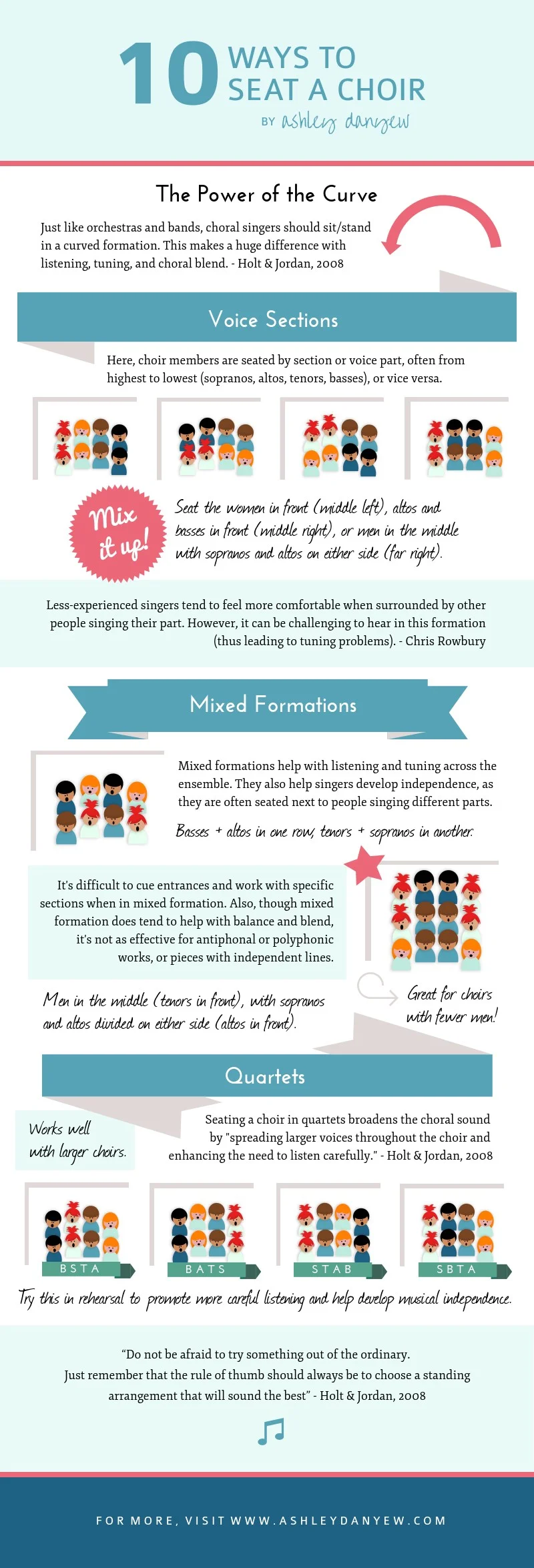
Infographic: 10 Ways to Seat A Choir
There are lots of thoughts and opinions out there on choral seating formations: some swear by sopranos and altos in front with tenors and basses behind, others advocate for stacking sections (front-to-back), and still others say mixed formations are the way to go. The truth is, there's really no right or wrong way to do it, though you may find some formations work better for your group or for particular pieces you're singing.
That's why, in today's post, I'm sharing ten different ways to seat a choir. I'm also mixing things up a little by sharing my first-ever infographic! Before we get into seating formations though, let's talk about one basic principle that applies no matter what:
The Power of the Curve
Sitting or standing in a curved formation makes a huge difference with listening, tuning, and choral blend (source). In The School Choral Program (2008), Michele and Holt and James Jordan describe two key reasons why sitting or standing in straight rows causes problems:

I'm Ashley—musician, educator, writer, and entrepreneur. Here, I share creative ideas and practical resources to help you build a successful career as a musician and teacher. Learn more >>

ONLINE COURSES
Develop the skills you need to lead and teach creatively and confidently with mini online training courses and workshops designed specifically for church musicians & music educators. Learn more and enroll >>

Get monthly updates
Get my free, 7-min. monthly newsletter—loved by 23,476+ musicians & educators. Subscribe >>

Listen to the podcast
Practical and pedagogical strategies, teaching
reflections, and insights from the field of music teaching and learning. Listen and subscribe >>

Printable Sheet MUSIC
Original music compositions for handbells, unison/2-part and
SATB choirs, solo piano & chamber instrumental ensembles. Buy now >>

Resource Library
A collection of printables, templates, and workbooks for music educators, piano
teachers, church musicians, and
music entrepreneurs. Browse the library >>