
34 Meaningful Quotes for Music Educators
Sometimes, it's important to remember why we started.
What first drew you to music? When did you know you wanted to teach? What are the pivotal moments that stand out in your memory—those particular students or experiences or revelations that propelled you forward, that fed your soul, that inspired you to keep going?
We all have our own answers and a whole collection of stories we could tell. This is one of the things I love most about teaching.
It's the heart behind what we do and the reasons why we do it that make teaching such a wonderful, life-giving profession (but maybe I'm a little biased?).
If you're looking for inspiration or a reminder of why you started teaching in the first place, I hope you find something encouraging in this collection of music quotes.
Today, I'm sharing 34 of my favorite inspiring and uplifting music teacher quotes. Enjoy!
34 Music Quotes for Music Teachers
“Tell me, and I forget. Show me, and I remember. Involve me, and I understand.” - Chinese proverb
“Music can change the world because it can change people.” - Bono
“Always be a first-rate version of yourself, instead of a second-rate version of somebody else.” - Judy Garland
“The art of teaching is the art of assisting discovery.” - Mark Van Doren
“Education is not the filling of a pail, but the lighting of a fire.” - William Butler Yeats
“Education is not preparation for life; education is life itself.” - John Dewey
“The mediocre teacher tells. The good teacher explains. The superior teacher demonstrates. The great teacher inspires.” - William Ward
“I’m not a teacher, but an awakener.” - Robert Frost
“If a child can’t learn the way we teach, maybe we should teach the way they learn.” - Ignacio Estrada
“Teaching is the one profession that creates all other professions.” - Anonymous
“I cannot teach anybody anything, I can only make them think.” - Socrates
“Never discourage anyone . . . who continually makes progress, no matter how slow.” - Plato
“Education breeds confidence. Confidence breeds hope. Hope breeds peace.” - Confucius
“If we teach today’s students as we taught yesterday’s, we rob them of tomorrow.” - John Dewey
“The best teachers teach from the heart, not from the book.” - Anonymous
“Spoon-feeding, in the long run, teaches us nothing but the shape of the spoon.” - E. M. Forster
“You can’t use up creativity. The more you use, the more you have.” - Maya Angelou
“The only way to do great work is to love what you do.” - Steve Jobs
“Alone we can affect a few. But together, we can change the world.” - Jen Hatmaker
“It isn’t where you came from, it’s where you’re going that counts.” - Ella Fitzgerald
“In learning you will teach, and in teaching you will learn.” - Phil Collins
“Your talent determines what you can do. Your motivation determines how much you are willing to do. Your attitude determines how well you do it.” - Lou Holtz
“The way to get started is to quit talking and begin doing.” - Walt Disney Company
“A year from now you may wish you had started today.” ― Karen Lamb
"It is the supreme art of the teacher to awaken joy in creative expression and knowledge.” - Albert Einstein
"A good teacher can inspire hope, ignite the imagination, and instill a love of learning." - Brad Henry
"I never teach my pupils. I only attempt to provide the conditions in which they can learn.” - Albert Einstein
“The greatest sign of success for a teacher . . . is to be able to say, ‘The children are now working as if I did not exist.’” - Maria Montessori
"The principle goal of education is to create men and women who are capable of doing new things, not simply repeating what other generations have done.” - Jean Piaget
"Don't let what you cannot do interfere with what you can do.” - John Wooden
"The greatest gift you can give another is the purity of your attention.” - Richard Moss
"A teacher's purpose is not to create students in his own image, but to develop students who can create their own image.” - Anonymous
"Nine-tenths of education is encouragement.” - Anatole France
"You can teach a student a lesson for a day; but if you can teach him to learn by creating curiosity, he will continue the learning process as long as he lives.” - Clay P. Bedford
Looking for more? See these posts:
21 Inspirational Quotes for the 21st Century Musician
30 Inspiring Quotes for Church Musicians
I’d love to hear from you:
What are your favorite teaching-related quotes?
Are you an introvert or an extrovert?
Society often makes us feel like we’re either one or the other. But these personality traits are actually opposite ends of the same spectrum.
And the reality is that most of us fall somewhere in the middle (source).
Susan Cain, researcher and author of the New York Times bestseller, Quiet: The Power of Introverts in a World That Can’t Stop Talking noted, "Extroverts need higher levels of stimulation to feel their best” while "introverts prefer quiet, minimally stimulating environments." (source)

Have you ever thought about how you give praise and offer encouraging words in your teaching? Is there a way to do this that promotes learning?
How can you use your words to foster the development of intrinsic motivation and a positive self-image in your students?

Rhythm pattern cards are a great way to teach new rhythmic concepts, reinforce familiar patterns, and build that all-important music vocabulary (the ability to understand and create your own musical patterns and sequences).
There are lots of different types of rhythm pattern cards out there - some you can buy, some you can download and print for free (like the set I'm sharing below!), and ideas for making some of your own.
They don’t have to be fancy! The ones I'm sharing today can be printed at home on white cardstock and cut into quarters (postcard-size).
It's one the greatest musical skills you can help your choir develop: singing and reading music for themselves with musical understanding.
Just like learning to read language, music-reading comes after listening and interacting with music aurally and developing a musical vocabulary of tonal and rhythm patterns (these are like words in language).
Think of how you learned to read: You probably spent a lot of time following along in a book as you listened to someone else read to you. Eventually, you started finishing the sentences and pointing to the words as you went along.
You learned simple words like, go and dog and identified them in other books.
Learning to read music is no different. We learn to recognize tonal and rhythm patterns like familiar words in books.

Are you looking for books you can sing or chant in your elementary music classes, group classes in your studio, or children’s choir rehearsals?
You know the ones: books that either have lyrics to a familiar children’s song or hymn, or stories with text that can be sung to a familiar tune, like “Twinkle, Twinkle, Little Star.”

As music teachers, it’s important to think about what motivates us as musicians and what motivates our students, choir members, and ensemble members to play and learn music.
I remember studying the theory of motivation as a grad student and was fascinated by the science behind it. For this reason, I really enjoyed reading Daniel H. Pink’s book, Drive: The Surprising Truth About What Motivates Us.
Fall is here, which means the return of Georgia football (Go Dawgs!), puffer vests, and apple everything (sorry, PSL).
It also means lots of repertoire planning and rehearsing for Christmas programs, musicals, and holiday concerts.
I recognize that some of you are in positions where you may be programming a holiday concert or program, whether that's a school or community setting or an interfaith musical celebration with area churches. If you're looking for choral music that touches on various Winter holidays and celebrations, I hope the list of anthems below is helpful to you.
Part-singing is one of the great joys of choral singing.
The challenge of singing an independent line and that satisfying feeling of creating harmony and musical interest is both fun and motivating for singers (of all ages!).
But how do you teach that?

Do you teach a preschool choir?
If so, you know that preschoolers are musical explorers. They love to sing, dance, play, move, and experience music with their whole selves.

I first heard about this book from one of my grad school professors.
We were sitting around a long table one snowy January evening at our annual dinner for current and prospective doctoral students. I asked my professor about books he was reading lately and he named several including Malcolm Gladwell's Outliers and Carol Dweck's Mindset.

What would you ask for if you were making a holiday wishlist for yourself as a teacher? New music? Curriculum resources? Piano-teaching games?
Today, I’m sharing a few ideas (and a few things that are on my teacher wishlist!) to help get you started. Enjoy!

I’m always looking for tools that are simple and easy to use. That’s why today, I’m excited to tell you about a (free!) web-based tool I’ve discovered to help me organize ideas, plan lessons, track assessments, and write curriculum content.

It’s normal to feel a little burnt out after the year we’ve just had. It’s normal to feel tired or frustrated or lost. But what have you learned? What strategies will you keep? How have the events of the last year changed us as teachers, as musicians? What will we do differently going forward?
Games and musical activities are a fun and engaging way to introduce and reinforce new musical concepts and develop musical skills like listening, singing, expression, coordination, and internalizing a sense of steady beat.
Today, I'm sharing a few of my favorite musical games and activities for elementary music classes, children's choirs, and elementary group classes.

Next week (May 24-28), I’m hosting the 3rd annual Music Education Basics, a free 5-day workshop for music educators.
With 60+ minutes of practical content, Music Education Basics is designed to give you clarity in your teaching and a fresh dose of inspiration and practical teaching ideas you can use right away.
But before you pull a new spiral notebook off the shelf and start mapping out ideas and making plans, let’s take a few minutes to assess where we are right now.

This year has brought some unprecedented challenges and the global pandemic has changed the way choirs and musical ensembles gather and make music together. Many choirs moved to online rehearsals this spring, using Zoom or Facebook Live to stay connected and try to continue making music the best they could. But with the technology we have available to us and unpredictable internet speeds at home, we’ve all learned that it’s really not possible to sing or play together in real-time.
Today, I’m sharing some helpful digital tools and resources that can be used in online choir rehearsals (synchronous or asynchronous) or in-person, if and when you’re able to return to that. You’ll find digital tools, game ideas, teaching strategies, and curriculum resources that were designed especially for distance-learning situations.
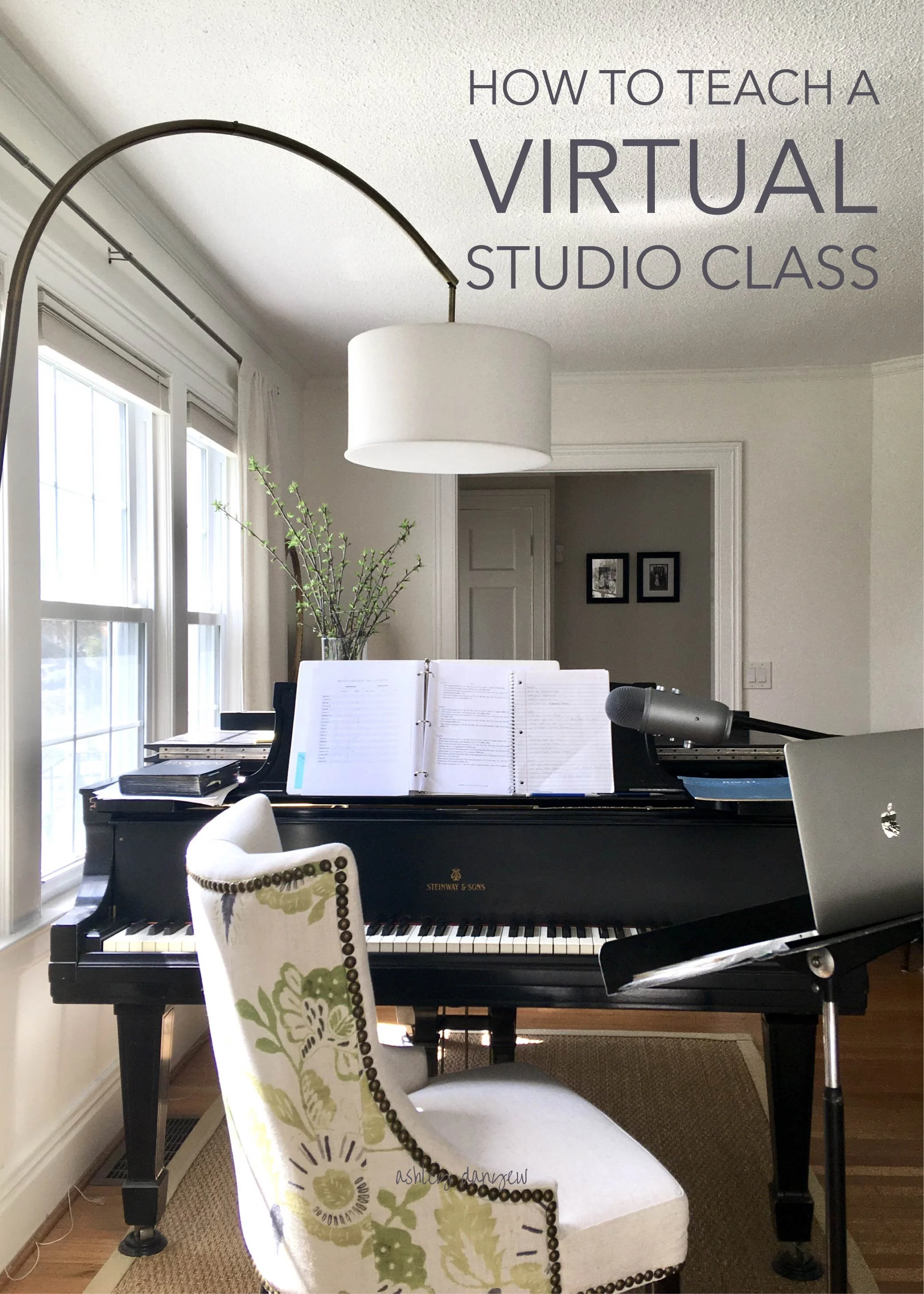
A few years ago, I started teaching monthly group classes in my studio.
The idea was to include more opportunities for informal performance, observation, musical discussion, and developing musicianship skills in a supportive group environment. All students are invited and encouraged to play something each time, even just part of a piece.
This gives us an opportunity to:
show works in progress
talk about practicing, learning processes, challenges, and rewards
give feedback (positive + constructive)
I also plan a few musical games and activities related to listening, movement, creative musicianship, and composition — things we can’t really do in our one-on-one lessons.
This year, I planned to teach five studio classes specifically for 3rd-6th graders, two studio classes for 7th-12th graders, and monthly buddy lessons for my K-2nd grade students.
But what to do when the world shuts down and everything moves online?
Host a Zoom studio class, of course.
Last week, I taught two studio classes (3rd-6th grade and 7th-12th grade) and two buddy lessons (K-2nd grade). Here’s a behind-the-scenes look at how I set these up, how I structured our time together, and what activities I created to play virtually.
Like many of you, I’ve been thinking a lot about how to teach music creatively online these past few weeks.
What tools work best to facilitate connection, dialogue, and musical experience?
What strategies lend themselves best to online teaching?
What assignments will foster music-learning during this time?
As many of us are navigating this new territory of learning how to teach online due to the COVID-19 pandemic, I thought I’d put together a master list of ideas for teaching in a variety of settings: church music, community teaching, and K-12 music.
I’m also including a list of tech tools that I’m using personally, have used in the past, or have heard recommended from other music teachers in the field.

If you walk into an elementary classroom, you might notice that everything is color-coded: signs and charts on the wall to labels on bins to pieces of tape marking certain spots on the floor.
This is because colors are easy for most young children to recognize and differentiate between.
But in music, our baseline is black and white, the colors of standard notation. When first introducing music-reading, it can be challenging for young students to recognize patterns and organize the content visually when everything is black and white.
For this reason, color can be a helpful tool when teaching music literacy and developing music-reading skills. “When we use color in a systematic way it can help students retain information better than just using black and white.” (source)
We’re living in unprecedented times.
With the recent worldwide outbreak of COVID-19, more and more schools and studios are choosing to close and transition to remote learning.
Maybe you’re like me in thinking that some subjects lend themselves well to being taught online: history, language, math. But music? How do you teaching piano to a 1st grader online? How do you teach choir or band? How do you teach group lessons?
This week, numerous music educators have put together resources, kits, and teaching guides to help others transition to online learning, learn about tools that are available, and get ideas. There are Facebook groups and webinars, blog posts and Google Docs summarizing all the music-related tech tools that are offering special discounts right now.
Here in Rochester, NY, schools are closed and moving online until further notice.
As such, I’m transitioning my studio to online learning. Today, I want to share what that looks like, including:
The notes I’m sending home to parents
Three models for online education I’m offering to all my students (K-10th grade)
Steps I’m taking to plan and prepare for this change
Resources and printables I’m pulling together for the next few weeks
Tools I’m using on the tech side of things
My best recommendations for studio teachers in this situation

We’ve heard it all before: the lore of work-life balance. Of doing it all, and doing it all well. And so we set out in search of the magical formula that will keep us in perfect balance, the solution to all our problems.
But secretly, we kind of wonder: is it real? Can it be achieved?
There’s been some debate recently as to whether or not this idea of balance between work and life is actually attainable. The thing is, the word balance makes it feel precarious: the feeling we have when learning to ride a bicycle, that we might lose our balance and fall over at any moment.
Not a great visual for life, just saying.

You know those things you’ve heard that seem true? I mean, they sound plausible. Plus, if enough people say it, it must be true, right?
Before long, we find ourselves buying into the hype, retelling the story, believing something we’ve heard without stopping to ask questions.
This is how myths begin.
Sometimes, there’s simply a lack of information—nothing to disprove this theory or that idea. Other times, they sound good on paper but are only surface-level with no substance to back them up.
Whatever the case may be, we’ve all encountered myths (big and small) in various parts of our lives.
But have you ever stopped to think about myths related to teaching and learning? What stories are being told out there that affect our work and how we approach things? What’s being shared as fact when there isn’t research to back it up?

Do you ever think back to the teachers you had growing up?
Maybe a private music teacher or a choir director or your high school English teacher or a professor you had in college.
What do you remember about them? What was your learning experience like? What approaches did you observe? What do you find yourself incorporating into your own teaching?
There’s an age-old adage that says we teach how we were taught.
This isn’t the full story, of course: we all have unique backgrounds and a variety of experiences that inform the people we are today and the teachers we are becoming.

Do you remember those songs we used to sing as kids that went on and on and on? That had what felt like a hundred verses, each one longer and sillier than the one before it?
This is the joy of a cumulative song.
From music class to road trips, playgrounds to choir rehearsal, cumulative songs are fun to sing, engaging for children of all ages, and an effective teaching tool.
For those of you who may not know what I’m talking about, a cumulative song is a song that adds a new phrase of text with each repetition.
Usually, the lyrics are a list of some kind, getting progressively longer as the song goes on.
Vocal exploration, or time spent exploring what the voice can do is a vital part of early childhood and elementary music-making. Invite your singers to experience what their voice can do and experiment with different types of sounds.
As you plan your choir rehearsals, look for new and creative ways for children to explore what their voices can do.
Spend a few minutes each week reviewing the four voices: speaking, singing, whispering, shouting. Then, take some time to create vocal sound effects that span the entire vocal range. This helps them build coordination and develop control of their voice, learn about their voice and what it means to sing, and build personal confidence.

Valentine’s Day is right around the corner!
Now, I know what some of you are probably thinking: Valentine’s Day isn’t a real holiday! Why should we “celebrate” this in our lessons and rehearsals?
I’m inclined to agree that Valentine’s Day is basically a Hallmark holiday, but at this point in the year, I’ll take pretty much any excuse to mix up my regular teaching routine and introduce something a little whimsical and fun (especially when gummy candy is involved!).

It’s the first week of the New Year and let me guess:
You’re looking back at 2018 and feeling a little worn out. You feel scattered. Your teaching approach feels haphazard and reactionary, and you wish you’d been a little more consistent these past few months.
You want 2019 to be different, but you’re not sure where to start.
You want to be the best teacher you can be, but taking on the task of improving your teaching skills is daunting. You’re not sure what to change or do differently.
Can you relate to that?

“Good! Now, sing it again.”
How many times do you hear yourself saying these words in rehearsal? We all know the importance of repetition. This is how we learn - by trying, experiencing, and doing it again and again.
The problem is, often, this becomes something we do mindlessly. When we hear someone say, “Good! Now, sing it again,”we go into auto-pilot mode and repeat whatever we just did without really thinking about it.
Did you catch that last part?

What does it take to direct a preschool choir? How is working with preschoolers different from working with elementary-age children? What do you need to know?
If you’re new to working with preschoolers or it’s been a while since you’ve been around this particular age group, here’s a quick guide to what it looks like to teach and direct a preschool choir.
I’m tailoring this to preschool choirs in church settings, but much of what I will describe here is applicable to choirs in school and community settings, as well.

The phrase score-study takes me right back to music history at 8 a.m. on Wednesdays (you, too?). Grout anthology in one hand, class notes in another, marking cadences and phrase structure and German augmented sixth chords.
Don’t worry—I’m not suggesting you analyze your ensemble music quite to that degree. However, the practice of studying a score—before teaching, rehearsing, or performing the piece has its merits.