
12 Favorite Supplemental Piano Books for Elementary Students

I love choosing supplemental repertoire for my students—even those who are still pretty new to reading and playing. This can be a great motivator and a good opportunity to really tailor your students’ repertoire.
I make recommendations to parents based on the student's interests and try to find supplemental books that complement the other music they’re learning.
It can be challenging sometimes to find repertoire that’s appealing, musical, and still at an accessible level. I look for music that’s expressive, well-crafted, technically challenging, and offers an opportunity to explore a new genre, style, or composer.
Grab a cup of coffee and your favorite notebook—here are a few of my favorite supplemental books for elementary piano students:
12 Supplemental Piano Books for Elementary Students
*Disclosure: I get commissions for purchases made through links in this post.
1. Celebrated Lyrical Solos, Book 1 (Vandall)
2. Celebrated Piano Solos, Book 1 (Vandall)
3. Piano Etudes - Preparatory (Snell)
4. Martha Mier's Favorite Solos, Book 1 (Mier)
5. Through the Windowpane (Tan)
6. PlayTime Popular, Level 1 (Faber)
7. PlayTime Piano Classics, Level 1 (Faber)
8. PlayTime Jazz & Blues, Level 1 (Faber)
9. Side by Side, Part 1 (Glennon/Cooper)
10. A Day in the Jungle (George)
11. A Day in the Forest (George)
12. Friends at Last (Glennon)
I’d love to hear from you:
What are your favorite supplemental resources for elementary students?

Piano duets are one of the most enjoyable ways to make music with another person—whether you're adding something special to a worship service, planning a studio recital or informance, or just looking for an excuse to sit down at the piano and play with a friend or student.
In my experience, most piano students love the chance to perform together, and even small churches have at least one person in the congregation with some playing experience. Often, people just need to be asked and invited to participate.
I love starting the New Year with a new reading list.
It’s my tradition here on the blog to share my book list in January: this year, I’m planning to read a mix of novels, personal & intellectual books, nonfiction & memoir, and a couple of business books to balance things out.

Have you ever thought about how you give praise and offer encouraging words in your teaching? Is there a way to do this that promotes learning?
How can you use your words to foster the development of intrinsic motivation and a positive self-image in your students?

One of my favorite ways to kick off the New Year is by diving into a new reading list. It’s become a tradition here on the blog to share my book picks at the start of each year—a mix of business insights, inspiring memoirs, thought-provoking nonfiction, and a few captivating novels to round things out.

Do your students love Halloween as much as mine do? 🎃
Every week they come to lessons so excited to tell me about their costume plans and the decorations in their classroom or at home.
Several years ago, I started introducing Halloween and fall-themed music and lesson activities during the months of October and November and it has been a big hit.
I choose games and activities for my beginning and elementary students to do throughout the month (or to use in our October studio classes) and I often choose a special piece of sheet music (or a piece to teach by rote) that ties in with the season.

Rhythm pattern cards are a great way to teach new rhythmic concepts, reinforce familiar patterns, and build that all-important music vocabulary (the ability to understand and create your own musical patterns and sequences).
There are lots of different types of rhythm pattern cards out there - some you can buy, some you can download and print for free (like the set I'm sharing below!), and ideas for making some of your own.
They don’t have to be fancy! The ones I'm sharing today can be printed at home on white cardstock and cut into quarters (postcard-size).

I love working with beginning piano students.
Our lessons are always full of imagination and creative exploration—their eyes wide with excitement and wonder when they make a connection or discover something new—and I always learn so much about myself as a teacher as we walk those first steps in their musical journey together.
That being said, we all know that when learning a new instrument, productive practice time at home is essential to learning and developing as a musician.
Most of us see our beginning students for only 30 minutes a week, so time spent at the keyboard in between lessons can really make or break a student’s progress and the fulfillment they find in music-making.

As music teachers, it’s important to think about what motivates us as musicians and what motivates our students, choir members, and ensemble members to play and learn music.
I remember studying the theory of motivation as a grad student and was fascinated by the science behind it. For this reason, I really enjoyed reading Daniel H. Pink’s book, Drive: The Surprising Truth About What Motivates Us.

Happy New Year! I’m excited to share my book list for 2024.
I like to vary my reading material throughout the year by choosing books from several different categories. Here’s what’s on this year’s list:
It’s that time of year—time to share my book list for 2023.
As you know, I like to mix up my reading material throughout the year by choosing books from several different categories.

A friend reached out recently to ask about how to find a piano teacher for her two young children.
"Any pointers on how to find the right person?" she asked. "Do you think going to a school is better or finding someone to come to us is better?"
The interview process for finding a music teacher goes both ways:

I first heard about this book from one of my grad school professors.
We were sitting around a long table one snowy January evening at our annual dinner for current and prospective doctoral students. I asked my professor about books he was reading lately and he named several including Malcolm Gladwell's Outliers and Carol Dweck's Mindset.

What would you ask for if you were making a holiday wishlist for yourself as a teacher? New music? Curriculum resources? Piano-teaching games?
Today, I’m sharing a few ideas (and a few things that are on my teacher wishlist!) to help get you started. Enjoy!
How can we as teachers add variety and musical interest to their repertoire lists? How can we include more diversity in the composers we choose and the musical styles we teach?
A few weeks ago, I wrote a post with 15 supplemental collections for elementary piano students. Today, I’m sharing my favorites for intermediate students.
Supplemental collections are a great way to 1) incorporate a variety of musical styles into their repertoire plan, 2) expose your students to new voices (especially those who are underrepresented), and 3) foster motivation. Here are 15 of my favorite collections for elementary piano students.

I’m always looking for tools that are simple and easy to use. That’s why today, I’m excited to tell you about a (free!) web-based tool I’ve discovered to help me organize ideas, plan lessons, track assessments, and write curriculum content.
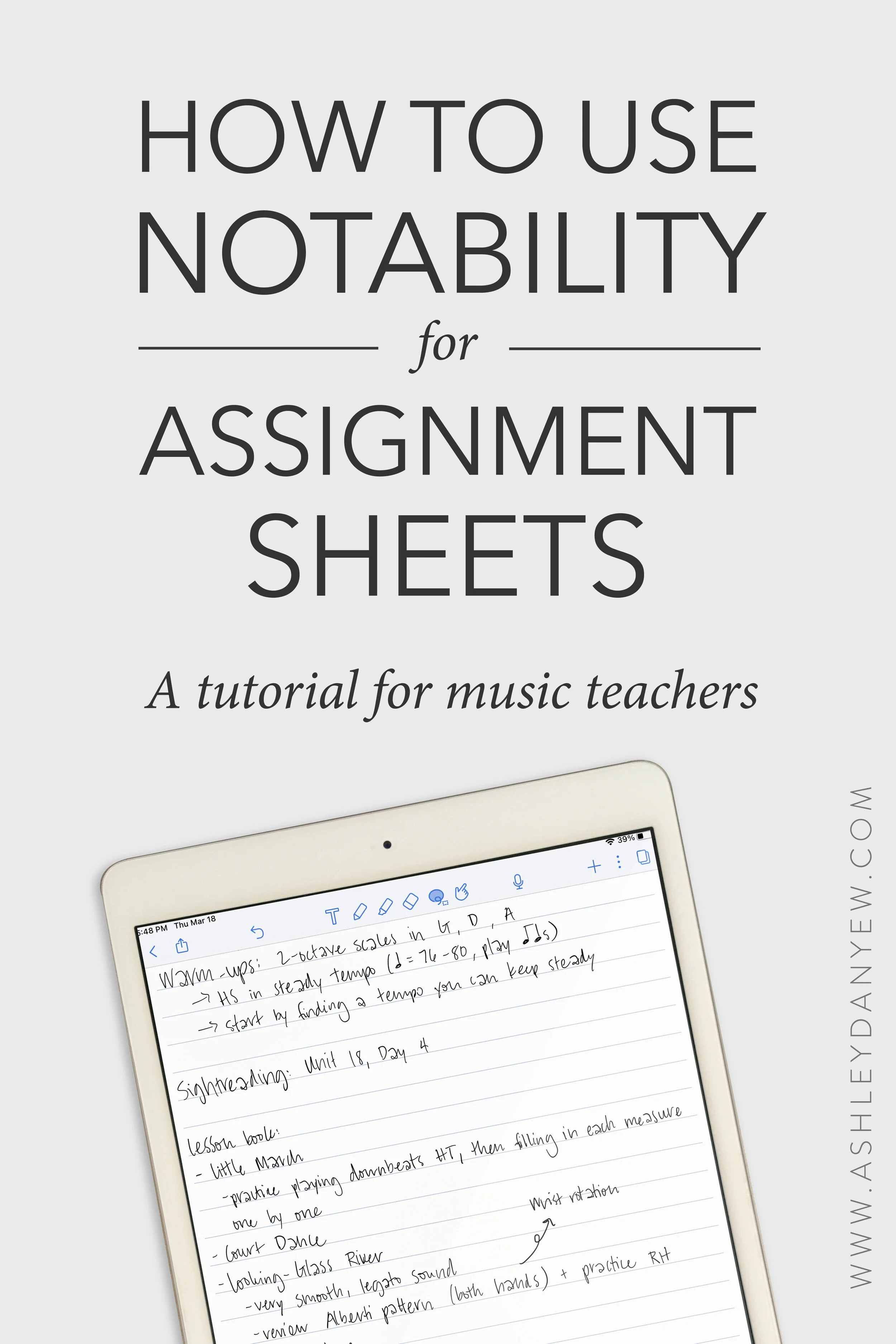
Confession: I’ve always struggled with written assignment sheets.
I know they’re important for home practice, but what about when a student doesn’t take their assignment notebook out of their bag all week? I wanted to find a better solution.
Looking for an alternative to handwritten assignment sheets in your studio? Here’s an easy 5-step guide to using Notability.
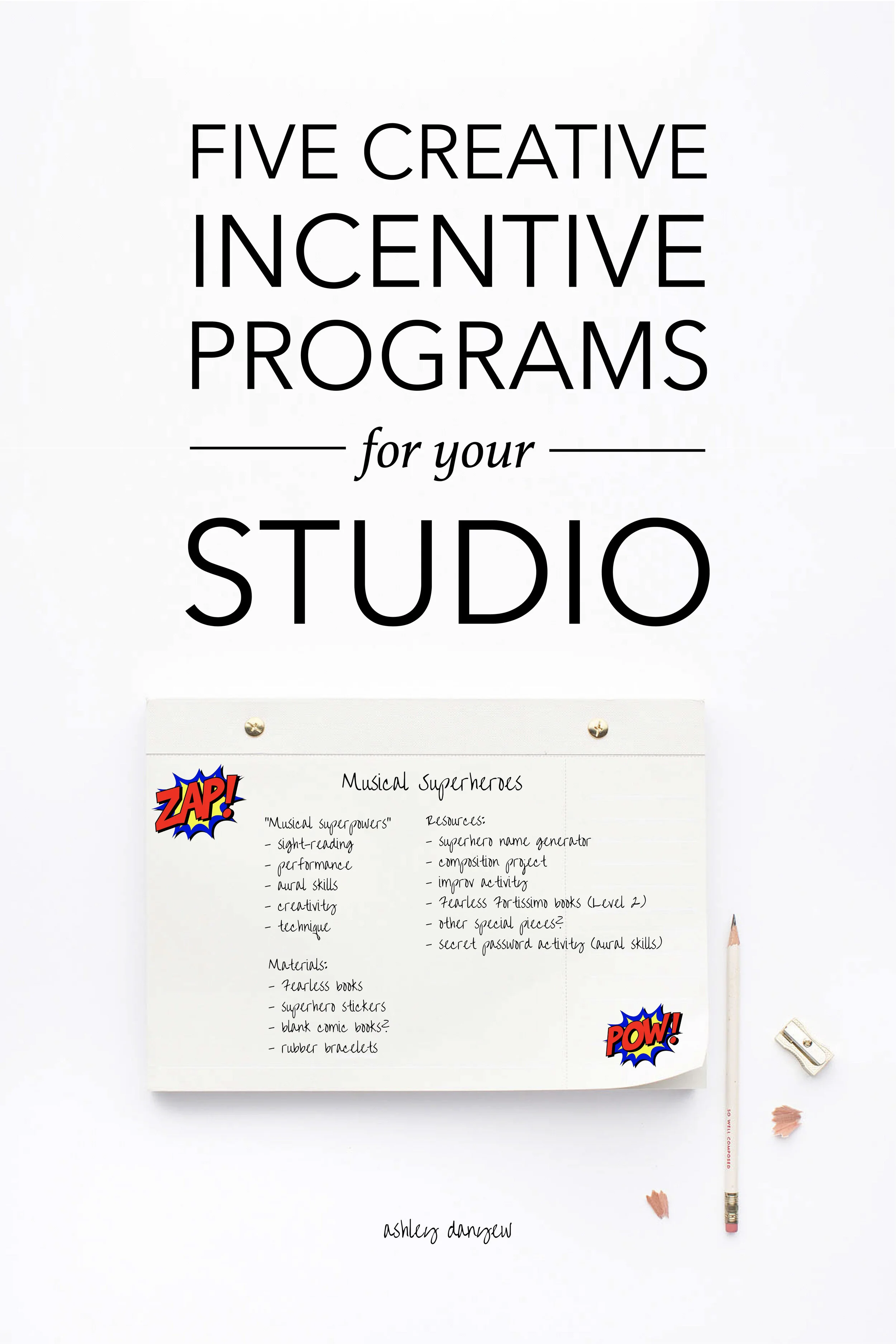
Have you ever used an incentive program in your music studio?
This might be a month-long practicing challenge, an annual assessment period, or a summer music camp (or other break-week).
This is a great way to keep momentum in the studio, encourage good practicing habits leading up to our end-of-year recital, and assess where my students are in all facets of their musicianship.
Looking for a fun, creative theme for your next studio incentive program? Here are five to consider.

Every year in my studio, we celebrate the end of the school year with a spring recital.
Each student prepares two pieces — sometimes memorized, sometimes with duets played by me or a parent or an older sibling or even a friend in the studio, and always with lots of supportive friends and family members in the audience.
This spring, like teachers around the world, I found myself suddenly immersed in the world of online teaching.
I knew that instead of gathering in person in the school theater on a Saturday morning in late May, we’d need to find another way to celebrate this year. We’d need to find a way to move the recital (like everything else in life) online.

A few weeks ago, I made the decision to keep my studio virtual this year.
Some schools are reopening here (with lots of precautions, staggered starts, alternating live and virtual days, etc.), including the school where I normally teach. I spent a lot of time this summer thinking about the in-person lesson experience and what that might look like:
A few years ago, I started teaching monthly group classes in my studio.
The idea was to include more opportunities for informal performance, observation, musical discussion, and developing musicianship skills in a supportive group environment. All students are invited and encouraged to play something each time, even just part of a piece.
This gives us an opportunity to:
show works in progress
talk about practicing, learning processes, challenges, and rewards
give feedback (positive + constructive)
I also plan a few musical games and activities related to listening, movement, creative musicianship, and composition — things we can’t really do in our one-on-one lessons.
This year, I planned to teach five studio classes specifically for 3rd-6th graders, two studio classes for 7th-12th graders, and monthly buddy lessons for my K-2nd grade students.
But what to do when the world shuts down and everything moves online?
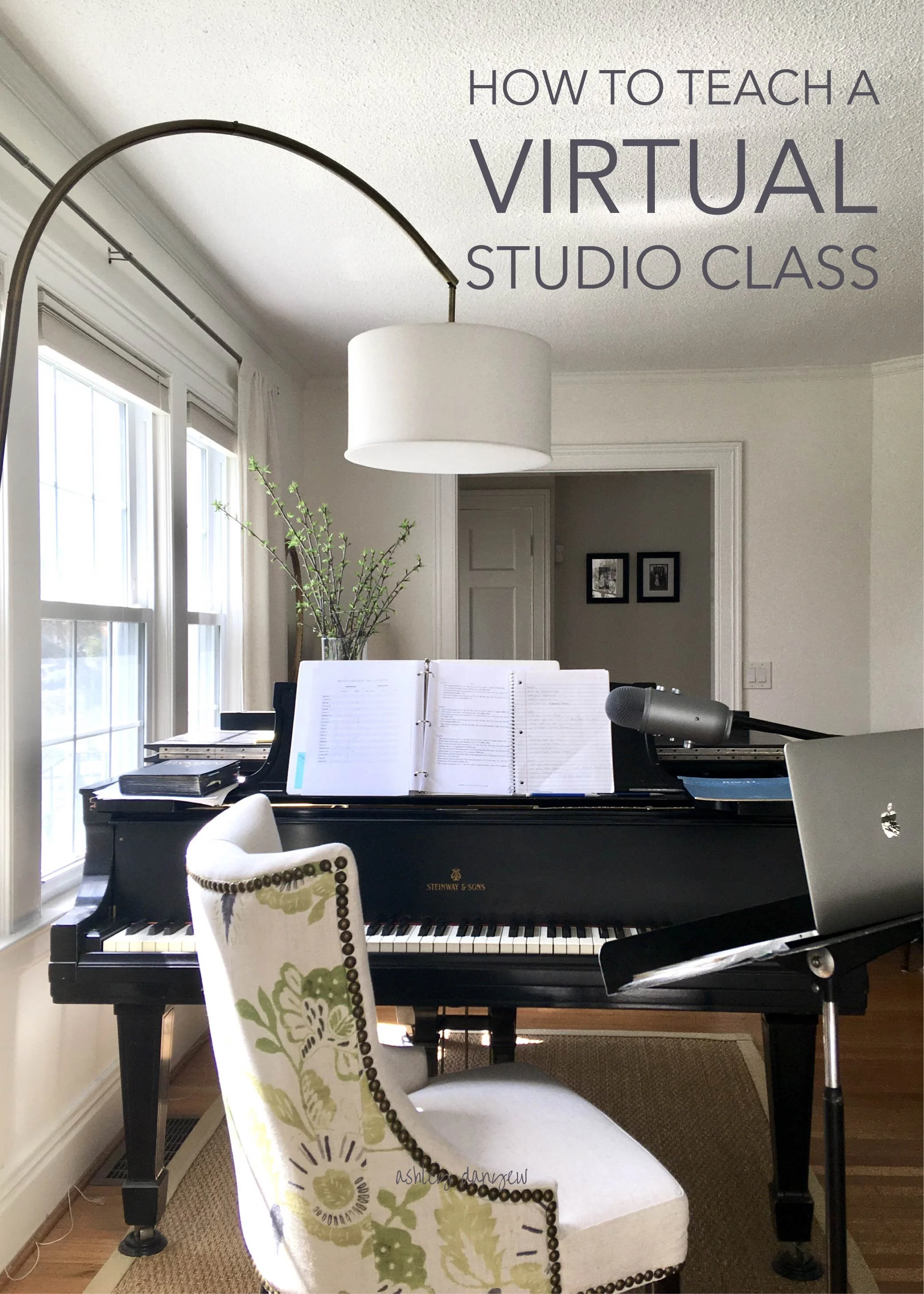
Host a Zoom studio class, of course.
Last week, I taught two studio classes (3rd-6th grade and 7th-12th grade) and two buddy lessons (K-2nd grade). Here’s a behind-the-scenes look at how I set these up, how I structured our time together, and what activities I created to play virtually.
Like many of you, I’ve been thinking a lot about how to teach music creatively online these past few weeks.
What tools work best to facilitate connection, dialogue, and musical experience?
What strategies lend themselves best to online teaching?
What assignments will foster music-learning during this time?
As many of us are navigating this new territory of learning how to teach online due to the COVID-19 pandemic, I thought I’d put together a master list of ideas for teaching in a variety of settings: church music, community teaching, and K-12 music.
I’m also including a list of tech tools that I’m using personally, have used in the past, or have heard recommended from other music teachers in the field.
We’re living in unprecedented times.
With the recent worldwide outbreak of COVID-19, more and more schools and studios are choosing to close and transition to remote learning.
Maybe you’re like me in thinking that some subjects lend themselves well to being taught online: history, language, math. But music? How do you teaching piano to a 1st grader online? How do you teach choir or band? How do you teach group lessons?
This week, numerous music educators have put together resources, kits, and teaching guides to help others transition to online learning, learn about tools that are available, and get ideas. There are Facebook groups and webinars, blog posts and Google Docs summarizing all the music-related tech tools that are offering special discounts right now.
Here in Rochester, NY, schools are closed and moving online until further notice.
As such, I’m transitioning my studio to online learning. Today, I want to share what that looks like, including:
The notes I’m sending home to parents
Three models for online education I’m offering to all my students (K-10th grade)
Steps I’m taking to plan and prepare for this change
Resources and printables I’m pulling together for the next few weeks
Tools I’m using on the tech side of things
My best recommendations for studio teachers in this situation

You know those things you’ve heard that seem true? I mean, they sound plausible. Plus, if enough people say it, it must be true, right?
Before long, we find ourselves buying into the hype, retelling the story, believing something we’ve heard without stopping to ask questions.
This is how myths begin.
Sometimes, there’s simply a lack of information—nothing to disprove this theory or that idea. Other times, they sound good on paper but are only surface-level with no substance to back them up.
Whatever the case may be, we’ve all encountered myths (big and small) in various parts of our lives.
But have you ever stopped to think about myths related to teaching and learning? What stories are being told out there that affect our work and how we approach things? What’s being shared as fact when there isn’t research to back it up?

Do you ever think back to the teachers you had growing up?
Maybe a private music teacher or a choir director or your high school English teacher or a professor you had in college.
What do you remember about them? What was your learning experience like? What approaches did you observe? What do you find yourself incorporating into your own teaching?
There’s an age-old adage that says we teach how we were taught.
This isn’t the full story, of course: we all have unique backgrounds and a variety of experiences that inform the people we are today and the teachers we are becoming.

This is a letter to all the parents and guardians and babysitters and older siblings and neighbors and friends who support young musicians: those who encourage the pursuit of music, tote children and books and accessories back and forth to lessons each week, and help with practicing at home.
Dear parents + guardians:
Thank you for supporting your child’s musical pursuits. You play a crucial role in your child’s success in learning to play an instrument. Even if you don't play the piano yourself, your support and guidance at home during the week is extremely important to their music-learning process.

A few summers ago, I attended the National Conference on Keyboard Pedagogy (NCKP) for the first time (read my recaps here, here, and here).
In addition to a wealth of new teaching ideas, I learned about new methods and curriculum materials, some of which I’ve been using in my teaching ever since.
Perhaps the most influential and valuable resource I discovered at NCKP was the Royal Conservatory of Music (RCM—Canadian division) and Music Development Program (MDP - US division).
Founded with a commitment to developing strong musicianship skills from the very beginning, the program includes level-by-level guides to repertoire, technique, and musicianship skills (plus supplemental materials for music history and theory) for a variety of different instruments.

Every year, I plan and create a 6-8 week incentive program for my piano studio. Mostly, this is for my beginning and elementary students (through 5th grade), though my middle schoolers (6th-8th grade) have been known to join in!
I’ve been doing this for a few years now, and I’ve found, while it's a great way to mix up our weekly lesson routine and give my students something fun to look forward to each week, it’s also a helpful way for me to assess their musicianship skills, take time to recognize their musical growth, and really tailor my instruction to each student.

Valentine’s Day is right around the corner!
Now, I know what some of you are probably thinking: Valentine’s Day isn’t a real holiday! Why should we “celebrate” this in our lessons and rehearsals?
I’m inclined to agree that Valentine’s Day is basically a Hallmark holiday, but at this point in the year, I’ll take pretty much any excuse to mix up my regular teaching routine and introduce something a little whimsical and fun (especially when gummy candy is involved!).
When was the last time you sat down at your instrument and played music for fun? I mean, not music you had to practice or prepare, not your students’ repertoire, not music for your next rehearsal, but music you chose to play for yourself, for your own enjoyment?
As professionals, we don’t often make time for this. We assume that all the music we’re being paid to learn and practice will also count as the musical satisfaction we need to keep going in our career.