
Holding On and Letting Go
January 2026It’s 9 a.m. and I’m practicing Bach: the Fugue No. 4 in C-Sharp Minor.
The subject starts soft and low, with long, ponderous notes that feel more like a harmonic outline than a melody. But soon it evolves into a tapestry of musical lines moving at four different speeds.
(Here's my version, recorded in my living room.)
A collection of pencil markings from a month of practice are scattered across the pages: finger substitutions, circles, slashes, and arrows propelling the sound forward. Highlighting musical texture like topography on a map. Ties drawn like suspension bridges, measure across measure.
A study in holding on and letting go, I think to myself.
And isn’t that what the end of one year and the beginning of the next always feels like? There’s reflection and nostalgia, happiness and maybe a little pride in how far we’ve come, but also sadness and grief and fatigue. Each a moving line we carry and layer on top of one another until we find ourselves caught up in the middle of something that resembles a 4-voice fugue.
A subject, an answer, an episode connecting one thought to the next. But really, it’s the ties that hold this one together.
The musical tie serves a few functions:
to extend note durations
to provide rhythmic clarity
to create smooth, flowing lines
In this fugue, ties create pedal points (a sustained pitch in the bass with shifting harmonies above), suspensions (moments of tension and release), and extended note durations as one line overlaps with the next.
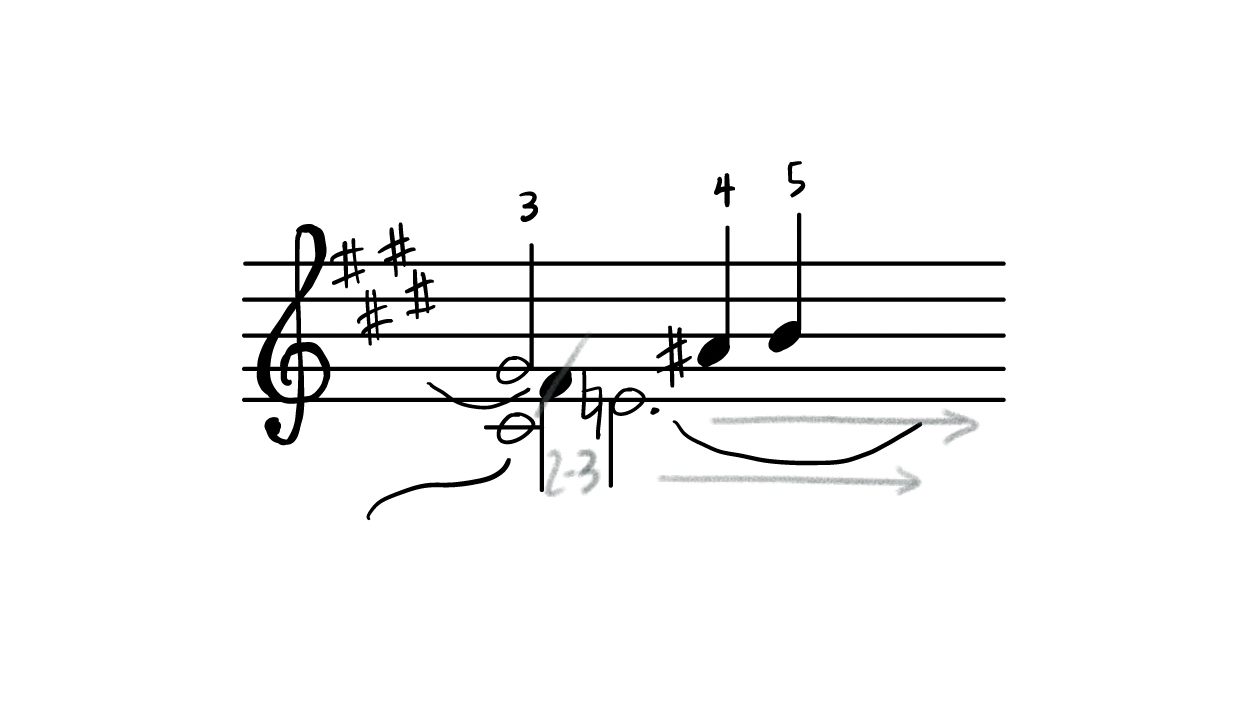
And so it is in life, too.
We live with this tension: choosing what to hold and when to let go. And unlike the Bach, it’s usually not clearly delineated. It takes awareness, careful listening, and paying attention to the music of our days as it unfolds.
Dialogue and sequencing, questions and answers. A pedal point of grief or gratitude (or maybe a little of both)—persistent, unmoving, grounding. An underscore to everything else. The things we carry with us from week to week or month to month—a legato line from past to present.
In a way, we’re all composers: making decisions and adjustments, communicating the depth of our lived experience, and creating beauty.
And so, I’ll return to my circles and slashes tomorrow, leaning into the moments of tension—sustaining, then breathing—letting the arrows show me the way forward.