
Worship Planning Theme: Music
“I play the notes as they are written, but it is God who makes the music.”

What a beautiful sentiment about the work of church musicians.
There’s something different about sharing music in a worship context—it becomes something greater than yourself, more than you could make it on your own. In a way, you become the instrument: “Take my voice and let me sing—always, only for my King."
I’ve written a few posts like this one, with music and worship-planning resources on a specific theme or topic:
Today’s theme is Music. If you’re planning a music festival or Music Sunday this year, here are a few resources and music suggestions to help get you started.
*Disclosure: I get commissions for purchases made through links in this post.
Music
Hymns
When in Our Music God is Glorified
For the Music of Creation
From All That Dwell Below the Skies
All Creatures of Our God and King
Come, Christians, Join to Sing
Holy, Holy, Holy
Wonderful Words of Life
Sing Praise to God, Who Reigns Above
Maker, in Whom We Live
Praise God, from Whom All Blessings Flow
Joyful, Joyful, We Adore Thee
Come, You Faithful, Raise the Strain
Praise to the Lord, the Almighty
Praise, My Soul, the King of Heaven
O For a Thousand Tongues to Sing
Rejoice, You Pure in Heart
Come, Thou Fount of Every Blessing
Now Thank We All Our God
This Is My Father’s World
For the Beauty of the Earth
Blessed Assurance
When Morning Gilds the Skies
Alleluia! Sing to Jesus
Lift Every Voice and Sing
O Worship the King
Take My Life and Let It Be
Songs
I Will Sing (Don Moen)
Here I Am to Worship (Tim Hughes)
Come, Now Is the Time to Worship (Phillips, Craig, and Dean)
10,000 Reasons (Bless the Lord) (Matt Redman)
How Great Is Our God (Chris Tomlin)
O Praise Him (David Crowder)
Everything That Has Breath (Reuben Morgan)
Be Praised (Michael Gungor)
Unbroken Praise (Matt Redman)
Come Let Us Worship (Chris Tomlin, Jesse Reeves)
I Could Sing of Your Love Forever (Martin Smith)
Shout to the Lord (Darlene Zschech)
Anthems
I Will Sing with the Spirit (Rutter)
I’m Gonna Sing When the Spirit Says Sing (arr. Helvey)
How Can I Keep From Singing? (arr. Courtney)
The Mighty Power of God (arr. Hayes)
With a Voice of Singing (Shaw)
We Are Made for Praise (Martin)
For All His Blessings (Danyew)
You Are the Song (Courtney)
O Come and Lift Your Voices (arr. Hayes)
Tune My Heart to Sing God's Praise (Larson)
You Are the Song (Martin)
This Is My Father’s World (arr. Hagenberg)
Sing a New Song! (arr. Larson)
When In Our Music God is Glorified (arr. McDonald)
Introits
Cantate Domino (Snyder)
Jubilate Deo (Praetorius)
Come, Christians, Join to Sing or other hymn verse
Worship Resources
Readings
A collection of Scripture verses about music
Litany: Sing a New Song! (based on verses from Psalms 30, 89, 92, 95, 96, and 100)
Calls to Worship
An ancient Call to Worship based on Psalm 150, written between the 3rd and 6th century
An intergenerational Call to Worship based on Psalm 100, written by Carolyn Brown
A contemporary Call to Worship based on Psalm 150, inspired by The Voice translation
A short, responsive Call to Worship based on Psalm 150
Poetic Reflections
Sing the Lord’s Song - based on Psalm 137:4
Rekindle the Gift - based on 2 Timothy 1:6
Many Members - based on 1 Corinthians 12:14, 21
Keep Singing
Other Ideas for Worship
Plan a brass fanfare or handbell processional at the beginning of the service
Incorporate musical underscoring - during the Call to Worship, litanies, or underneath prayers or readings
Plan a combined anthem for all your choirs to sing together
Include a Psalter reading: Psalm 100 or Psalm 150 (with sung response)
Use hymn descants, by sopranos (or tenors!), handbells, or a solo instrument
Put together a small instrumental ensemble. Here are a few music resources for flexible instrumentation.
See more ideas in this article: Ideas for Music Ministry Sunday
“The aim and final end of all music should be none other than the glory of God and the refreshment of the soul.”
I’d love to hear from you:
Have you ever planned a Music Sunday or festival?

When we talk about singing, especially singing in a community or congregational setting, we often ask, "Is it singable?"
This simple question may sound arbitrary but there's actually a lot of care and thought that goes into determining the answer.

I don’t know about you, but I love taking a look behind the scenes.
Maybe it’s curiosity or intrigue, maybe it’s an interest in learning about other people’s processes, creative approaches, and perspectives on things.
If you’re a church musician or someone who contributes to worship planning, then you’ll love today’s post.
Today, I’m giving you a behind-the-scenes look at how to choose hymns that tie into worship.

Lent begins two weeks from today—Wednesday, February 26.
For most denominations, this is a season marked by quiet confession, sacrifice, and reflection.
Maybe you’ll give something up this season (like caffeine or cookies or social media) or maybe you’ll take something on (exercise, prayer, or solitude).
Maybe you’ll walk a labyrinth or participate in a Taizé service or do some fasting.

A few months ago, I received an email from a friend:
“Hi Ashley! I am looking for hymn accompaniments for four hands at the piano. Not arrangements, but the actual hymn. We will be without our organ for some months and I want to beef up the piano sound by adding hands. Do you know of any books with this? Or websites? I guess we could just play in octaves, but maybe there is something interesting out there."
Can anyone relate?
Whether the organ is undergoing repairs, that F# is in need of a good tuning, or you show up one morning and the power is out…
Sometimes, you need to use the piano to accompany the hymns.
But if you’re in a large space, the piano may not be enough on its own to really support and lead the congregation in song. What’s a church musician to do?
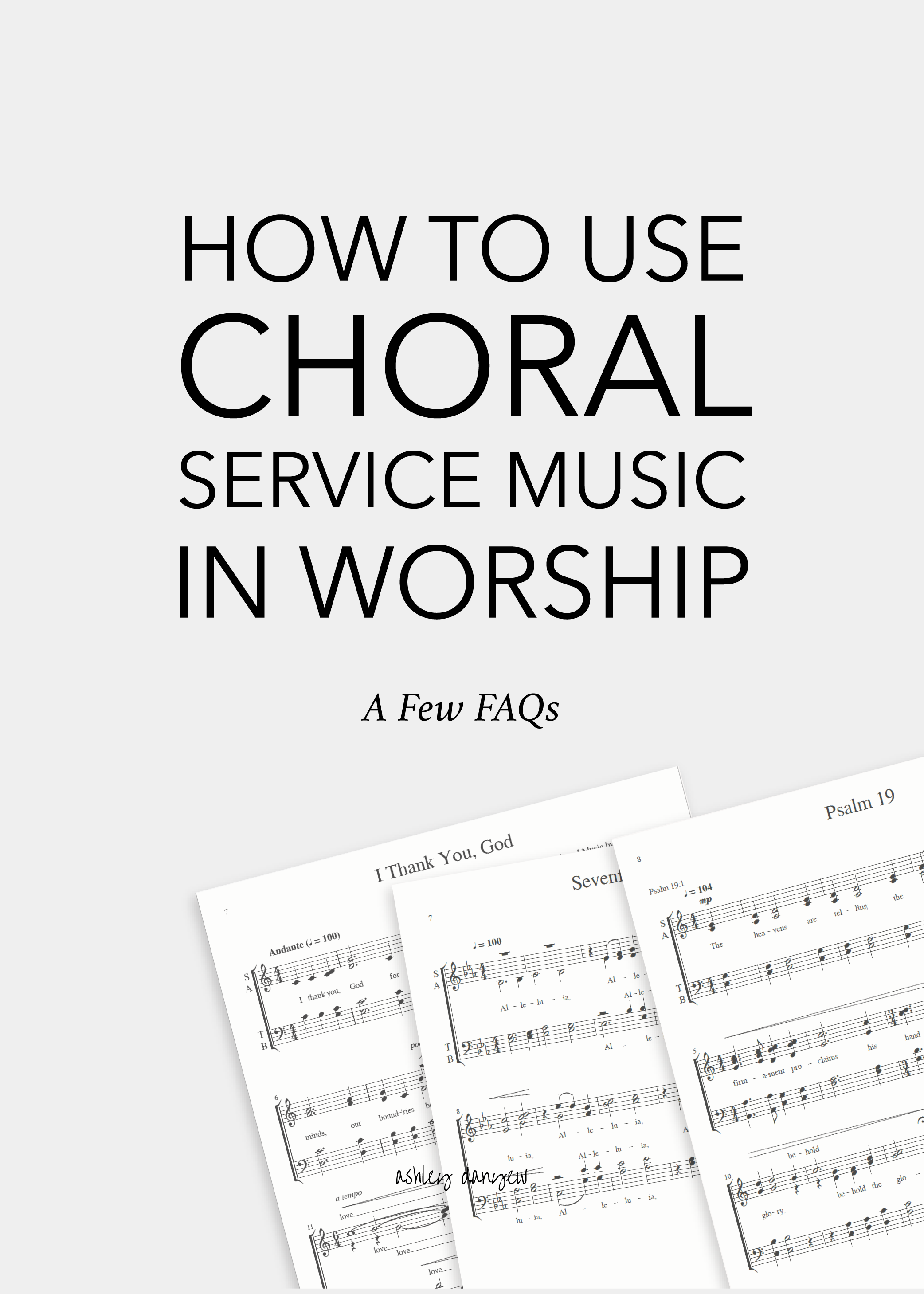
There’s something to be said about the power of music in worship: the ability to imbue an experience with meaning, inspire the hearts and minds of those listening, create space for personal reflection, and offer an opportunity for transcendence.
Yes, it’s functional and it provides a nice contrast to the spoken word, but music has an inherent ability to create meaningful, shared experiences, as well.
This is why service music is such a powerful tool in worship planning.
Today, I’m delving into a few FAQs about choral service music, specifically: what it is, why it’s important, how to use it, and where to find it.

Mother's Day, though not a sacred holiday, is often observed in some way in churches of various denominations.
The day actually originated in a Methodist Episcopal Church in Grafton, West Virginia in May 1907, when Anna Jarvis, organized a special service to honor her late mother. The next year, Anna advocated that the second Sunday in May be a day to honor all mothers. Mother’s Day became an official holiday in 1912.

Hanging of the Greens is a traditional Christian ceremony of decorating the church for the Advent and Christmas season, often celebrated on the first Sunday of Advent or during a separate evening service.
Some churches have a Hanging of the Greens service on a Sunday afternoon, the week before the first Sunday of Advent. Others have a workshop-style event the day before the first Sunday of Advent, where families come and learn about the significance of our Christmas decorations and help prepare the church for the new season.

The first Sunday in Advent is only seven weeks away!
Advent is a journey; that season of waiting and preparation leading up to Christmas. It’s the beginning of a new liturgical year, a time when we gather in darkness and wait for the Light of the World to come again.
We re-read the ancient prophecies, we hold on to hope, we remind ourselves what it means to trust in God’s promises and receive God’s peace. We celebrate the gift of joy to the world and the light God shines into the dark places.
Have you ever flipped through your hymnal and come across all those indexes in the back?
The one we probably use most often is the Index of First Lines and Common Titles - a quick way to find the page number for a particular hymn you want to sing or play. Another index that sometimes proves helpful is the Index of Hymn Tunes, where you can look up a hymn by its tune name (for instance, NEW BRITAIN for “Amazing Grace” or HYMN TO JOY for “Joyful, Joyful”).

Have you ever noticed the details of your denomination's logo or emblem? Have you ever wondered about the significance of the shapes or symbols included or the colors used?
If so, this post is for you.
First, a little back-story: Last year, I did some research on the history of several mainstream Protestant denominations and what sets them apart in terms of beliefs and organizational structure. Read it here, in case you missed it.

Have you ever wondered what those letters on the altar stand for? What is the significance of the symbols in the stained glass windows? Why is a fish a symbol of our Christian faith, and what does a peacock have to do with anything?
Yes, the church is full of sacred signs and symbols that tell us about our past - our history - and inform our faith. Each one has some significance and connection to our faith, and each one represents a time in history, a story, a body of believers.

When I was in high school, I heard a pastor explain grace in the form of an acronym: God’s Riches at Christ’s Expense.
Grace is a gift, an invitation to receive God’s riches and become heirs of God’s kingdom.
I grew up in a United Methodist church, and the more I learned about what it means to be Methodist, the more I learned about grace.
You see, John Wesley, the founder of the Methodist movement, considered grace the cornerstone of the Christian faith. He described God's grace as having three different forms: Prevenient Grace, Justifying Grace, and Sanctifying Grace.

“A lectionary is a collection of readings or selections from the Scriptures, arranged and intended for proclamation during worship of the people of God.” (source)
Used as a guide in services of worship across denominations, the lectionary is a useful tool for choosing and sequencing Scripture readings and related music and liturgy for weekly worship.
Today, I’m writing about the Revised Common Lectionary - its history, benefits, how it's organized, and how to use it to guide your worship planning from week to week.
Let's get started!

What does it mean to have good flow in worship?
For me, flow means:
- continuity
- cohesion
- an uninterrupted experience
- continuous movement in one direction without bouncing around, pausing, or redirecting partway through
In contrast, a worship experience without flow may feel:
- disjointed or mismatched
- inconsistent
- confusing or disconnected
- distracting
- awkward
- thrown together

Epiphany, celebrated on January 6, marks the end of the Christmas season (commonly referred to as the 12 days of Christmas).
It’s a time in the liturgical year when we remember the magi’s journey and Jesus being revealed as the Savior of the world. In fact, the word “Epiphany” comes from the Greek epiphaneia, meaning “manifestation” or "striking appearance.” (source)
In some churches, Epiphany is considered the start of a new season that runs through the Tuesday before Ash Wednesday and the beginning of Lent. In other churches, Epiphany is celebrated as a single day, and the period that follows is considered Ordinary Time. (source)

I don’t know about you, but I love taking a look behind the scenes.
Maybe it’s all the second-guessing that goes on in my head on a daily basis (Am I doing this right? Is this the best way? Is this how other people do it? etc.) or maybe it’s my curiosity for learning about other people’s processes, creative approaches, and perspectives on the everyday things that I spend some of my time doing, too.
I find there’s always something to learn from watching others work through a problem or task - their step-by-step process, their insight, their strategies - I find it fascinating and informative. Next time that I sit down to work on a similar task, I have a few different options and ideas of ways to go about it.

Advent.
A time of waiting, watching, listening.
A time of remembering, anticipating.
A time of renewal and wonder.
The beginning of a new year.
Each year, we celebrate the season of Advent in the weeks leading up to Christmas. We read the words of the prophets, we tell the stories of Mary and Joseph, the shepherds, the angels, the magi.
We put ourselves back in that time and place of watching and waiting for the Savior of the world, expectant and hopeful. And then, we find ourselves here, in the 21st century, watching and waiting for the return of our Savior, expectant and hopeful.
Often times, our worship services during Advent have a particular sequence to them: We begin with the prophetic words of hope and faith; then, the promise of peace in the world; the joy of God’s fulfilled promises; and the gift of love into the world.

The arts - whether it's music or dance or drama or visual - are a wonderful way to enhance the worship experience, engage the congregation, bring stories to life in new ways, and create meaningful, memorable experiences for all involved.
Related post: Integrating Visual Arts in Worship
The term "worship arts" means different things at different churches, but often times, it includes things like:
- altar decorations
- paraments
- banners (including ribbon and streamers)
- visual aids for worship
- flower arrangements, wreathes, and other decorations
- visual art
- audio and visual technology
- dance
- drama
There's been an effort at my current church to incorporate more of these things into our worship services on a regular basis, so last year, I started a worship arts team.

What's in a name?
Most of us, if asked, probably have some sense of denominational affiliation, or at least partiality. Perhaps you grew up with close ties to a certain denomination. For some of you, maybe you've been able to work within that same denomination throughout your career. For others of us, our work experience is varied - based on jobs that become available, places we live, worship styles, family decisions, etc.
I know, for me, my experience includes Episcopal and United Methodist (growing up) and United Methodist, Disciples of Christ, UCC, Presbyterian, and American Baptist/United Methodist throughout my career.
If you’ve ever been in a position where you’re considering a move to a new-to-you denomination, you’ve probably found yourself asking/googling questions like:
What do Episcopalians believe?
How are Methodists different from Lutherans?
What sets PCUSA churches apart from PCA?
What does it mean to be congregational?
To delve into some answers to these questions, we need to step back in time for a little history lesson.

Each year, we celebrate the gift of the Holy Spirit on Pentecost Sunday.
On Pentecost Sunday, we remember the story from the book of Acts about how the apostles gathered, were filled with the Spirit, and with tongues of fire resting above their heads, began spontaneously speaking in different languages.
This was the beginning of the church, in a way — a group of people that gathers together and goes forth to share the Gospel throughout the world.

For many churches, the lectionary (a pre-planned collection of readings to choose from each Sunday) is the guiding force behind worship planning.
Perhaps the two most well-known forms of the lectionary are the Revised Common Lectionary (RCL), a 3-year cycle first published in the early 1990s and the Ordo Lectionum Missae (1969) on which the RCL is based, which emerged after the Catholic Church's Second Vatican Council. (source)
The Ordo Lectionum Missae has been revised and updated (and translated into English) since then and is still used in many Catholic Churches (now called the Lectionary for Mass). The RCL, which is likely familiar to many of you, is used across denominations in churches around the world.
But, in the last several years, new lectionaries have emerged, giving churches an opportunity to explore new reading plans and guides for worship.
Last Fall, Mandy Davis of Central Presbyterian Church in Anderson, SC reached out to me for resources and music planning ideas for the relatively new Narrative Lectionary (2010), a 4-year reading plan that follows a more continuous, “narrative” approach, created by Luther Seminary. After exchanging a few emails, I asked if I could touch base with her later in the year to see how it’s going.
Today, I've invited Mandy on the blog to share her experiences (from a church musician's perspective) and talk about her favorite Narrative Lectionary resources. Enjoy!

"I play the notes as they are written, but it is God who makes the music." - J. S. Bach
What a beautiful sentiment about what we do as church musicians.
There’s something different about sharing music in a worship context - it becomes something greater than ourselves, more than we could make it on our own. In a way, we become the instruments, ready to be used by God, for His glory: “Take my voice and let me sing - always, only for my King."
I’ve written a few posts like this one, with music and worship-planning resources on a specific theme or topic. Here are the links, in case you missed them:
Today’s theme is Music. I’m writing this post for myself, really, because we’re in the midst of planning a Music Sunday at our church for later this Spring - a day to celebrate God’s gift of music and bring together as many of the church’s musicians as we can to offer our praise and thanksgiving.

Easter is one of the most joyous, celebratory, hope-filled Sundays of the church year. It’s the day we celebrate Jesus’ triumphant resurrection, the fulfillment of the prophecies, and the hope of everlasting life to come.
All of these things make Easter Sunday the perfect time to pull out all the stops (so to speak). From handbell choirs to soprano descants, brass ensembles to fanfares, there are lots of things you can plan to match the joyful spirit of the day and speak to the hope we celebrate.
But, there’s something more to the Easter story. That first Easter morning was a surprise.
Yes, Jesus had been talking about his death and resurrection (in metaphor) leading up to that day, but no one really understood what he meant. No one could comprehend what would happen. Especially after he was dead and buried in the tomb.

Holy Week is a special time in the church year.
We retell the old, old story of Jesus gathering with his disciples, washing their feet, and breaking bread with them; praying in the garden; being betrayed and condemned to death on a cross; and laid in a tomb sealed with a stone. It’s a somber week of remembrance and reflection on God’s great gifts of love, grace, forgiveness, and redemption. But, we all know how the story ends: with victory, resurrection, hope, and new life.
Some churches have services every day during Holy Week; others may have only one or two services. Maundy Thursday, the remembrance of the Last Supper, and Good Friday, the remembrance of Christ’s sacrifice for us, are the two most common Holy Week services.
We’re in the midst of finalizing our plans for our Maundy Thursday service this year and are leaning toward a more emergent service, with art, music, readings, and communion around the table.
Looking to create something similar for your church? Here’s my step-by-step process:

Throughout the Bible, there are many analogies of sheep and their shepherds:
Moses was a shepherd for the Israelites, leading them through the wilderness for 40 years.
David was a shepherd before he became King of Israel.
Jesus described himself as "the Good Shepherd” in John 10, one who “lays down his life for his sheep."
We hear about sheep and shepherds in the Parable of the Lost Sheep, where the shepherd went after the one sheep who had strayed from the fold and did not stop looking until he found it. We read about God as our shepherd in Psalm 23 and throughout the book of Psalms:
"But he brought his people out like a flock; he led them like sheep through the wilderness." (Psalm 78:52)
"Come, let us bow down in worship, let us kneel before the Lord our Maker; for he is our God and we are the people of his pasture, the flock under his care." (Psalm 95:6-7)
"Know that the Lord is God. It is he who made us, and we are his; we are his people, the sheep of his pasture." (Psalm 100:3)

"The more that you read, the more things you will know. The more that you learn, the more places you'll go.” - Dr. Seuss
There’s a lot of truth in that statement. And the exciting thing is, we are never done learning. There are always new ideas, new processes, new perspectives to discover, explore, and seek to understand.
Reading is a great way to escape, unwind, and rest, but it’s also a useful way to learn, grow, and find inspiration. In our work as musicians and teachers, directors and coordinators, worship leaders and planners, this is extremely important.
A few years ago, I shared a few book recommendations for church musicians - choir directors, children’s choir directors, organists and accompanists, and others. Today, I’m sharing a book list for worship leaders - those of you involved in planning, leading, and facilitating worship services (traditional, contemporary, and everything in between).

Lent, as a season, is about reflecting, simplifying, cleansing. It’s about searching our hearts, forgiveness, and grace. It’s also about love and freedom and growth.
It’s a time we remember Jesus being tempted in the desert for 40 days (hence the reason Lent is 40 days long), teaching the people about God’s love and how we should love others, breaking bread with his disciples, and living out God’s will for his life.
In Lent, we refocus on the renewing waters of baptism, the cleansing river, the fountain of grace.
Some say that the Sundays in Lent are not counted as part of the 40 days; rather, they are considered celebration days or “little Easters" (source). But I think this is missing the point a little: Lent is a journey, a time of self-reflection and examination of the heart, a time when we invite God in to do the work of shaping us and molding us into His likeness.
It’s a process, and it takes time.
How can we create space for this in worship? How can we make this season more meaningful? How can we capture the quietness, the self-reflection, the invitation to come just as we are in our Lenten services?

How do you plan a worship service? Where do you start?
It’s likely that the process looks different from church to church and worship planner to worship planner, but I thought it might be helpful to share an inside look at my worship planning process, from start to finish.
Before I do that, however, I want to share a few articles and resources that have been helpful to me:
UMC Discipleship - Worship Planning - sample orders of worship, sermon notes, hymn/song suggestions, and other resources (click “This Week’s Planning Resources” to see worship planning suggestions for each week)
A Single-Thread Worship Planning Model - an insightful look at integrated liturgy and the benefits of planning sermon series
The Nuts and Bolts of Worship Planning - "collected wisdom from 100 congregations"

There are some themes and symbols that appear over and over again in scripture: creation, light, bread, water. And every few weeks, I seem to find myself planning around a certain theme and searching for worship planning inspiration:
“hymns about light”
“songs about water”
“ribbon banner for worship”
You, too? Okay, good. Based on my own planning for a service later this spring, I’m sharing my favorite stories, music, and worship planning ideas for services about water.
Water symbolizes baptism and rebirth, healing and renewal, creation and order from chaos. It ebbs and flows, waves and ripples: a living, moving thing. It sustains us and life on earth. It cleanses us and makes us new.

In February, we celebrate Black History Month—an annual observance in the U.S., Canada, Ireland, and the U.K. (and perhaps other places, as well) honoring the history, achievements, contributions, sacrifices, and struggles of African Americans.