


Holiday Gift Guide: Gifts for Choir Members
It's the most wonderful time of the year! Rehearsals are well underway, the annual Choir Christmas Party is being planned, and the sanctuary is fully decorated with wreaths, garlands, and candlelight.
But there's one item at the bottom of your to-do list you just can't seem to check off - "gifts for choir members". You want to show your choir that you appreciate them - their gifts of time and energy and support throughout the year - but you're at a loss as to what kind of gift would be thoughtful, affordable, and meaningful to all members.
That's where this post comes in.

The Church Choir's Guide to Vowels: Part II
Earlier this week, I shared Part I in a new series called "The Church Choir's Guide to Vowels. Part I included everything you need (and ever wanted) to know about vowel production, vowel placement, tone, and diphthongs and triphthongs.
Today, I'm sharing Part II with some of the most common "problem vowels" and helpful strategies for fixing them in rehearsal.
But, before we can get talk about problem vowels, we need to talk about what they look (and sound) like and how to diagnose them.
Here are some common choir problems you may have faced:
Problem #1: My choir has a tendency to sing flat or sharp.
This might be related to a lot of things - breath, posture, vocal production, etc. But, it might also be a vowel problem. If that's the case, manipulating the vowels a bit might do the trick.

The Church Choir's Guide to Vowels: Part I
Whenever I think of vowels, I think of this scene from Singin' in the Rain:
Any other Singin' in the Rain fans out there?
All jest aside, vowels are a vital component of the English language - spoken and sung. We talk a lot about consonants with our choirs, particularly with words like "God" and "bread" and "heart" that have strong beginning and/or ending consonants. But, what about vowels? How do we talk about them?
For those of you who studied voice or have read up on vowel production, you might know the difference between pre-, post-, and medio-palatal regions off the top of your head. For the rest of the world, the subtleties of vowel production, tongue placement, tone, and IPA symbols are a little more vague and mysterious.
And when it comes to talking about these things with your choir? Well, you can imagine how that might go (and all the jokes the basses will make).
But, no matter your background or the level of your choir, vowels are a significant and vital part of choral-singing. In fact, "Vowels are just as important for intelligibility as are consonants." (source)
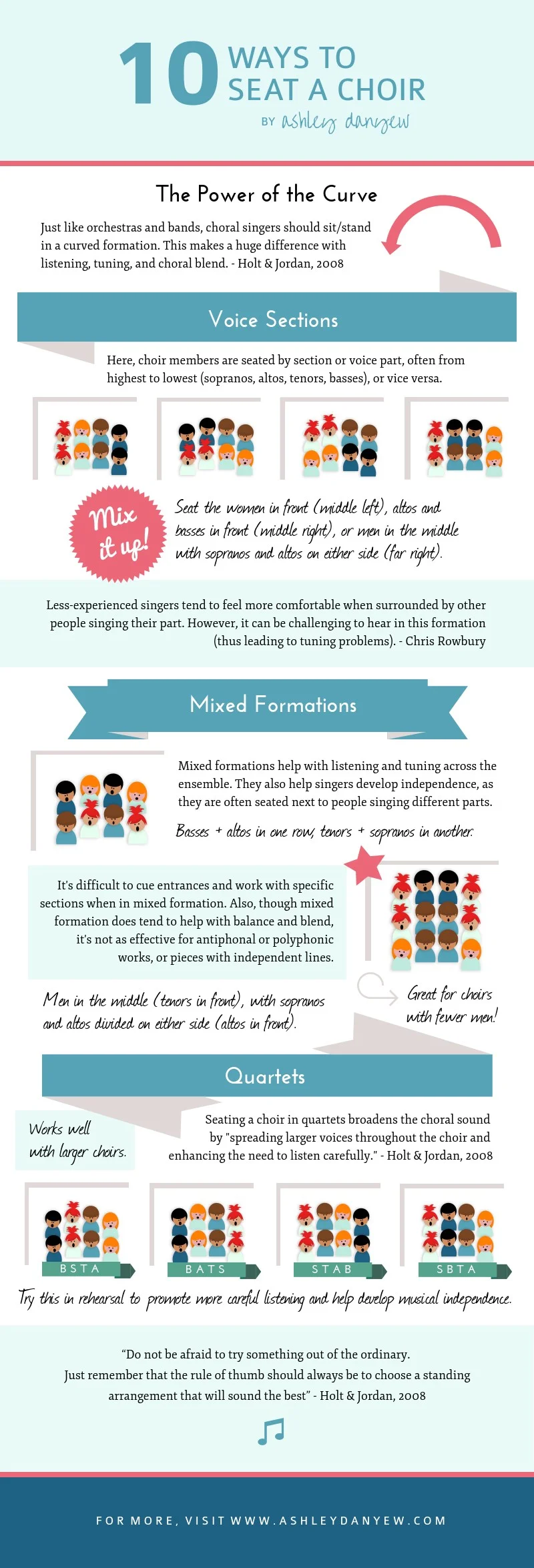
Infographic: 10 Ways to Seat A Choir
There are lots of thoughts and opinions out there on choral seating formations: some swear by sopranos and altos in front with tenors and basses behind, others advocate for stacking sections (front-to-back), and still others say mixed formations are the way to go. The truth is, there's really no right or wrong way to do it, though you may find some formations work better for your group or for particular pieces you're singing.
That's why, in today's post, I'm sharing ten different ways to seat a choir. I'm also mixing things up a little by sharing my first-ever infographic! Before we get into seating formations though, let's talk about one basic principle that applies no matter what:
The Power of the Curve
Sitting or standing in a curved formation makes a huge difference with listening, tuning, and choral blend (source). In The School Choral Program (2008), Michele and Holt and James Jordan describe two key reasons why sitting or standing in straight rows causes problems:

3 Tips for Playing Open Score (For Choral Accompanists Everywhere)
As all choral accompanists know, playing from open score is a fact of life. At one point or another, you'll likely find yourself sitting at the keyboard in front of a choral score with no piano reduction, forced to muddle your way through reading four lines of music at the same time. How can you prepare? What can you do to develop this skill?
If you have the opportunity to practice in advance, there are a few things you can do:
1. Practice systematically.
This is probably the most common piece of advice you'll receive, but careful, systematic practice is a helpful first step toward developing this skill and training your eyes to read four lines of music at once. Begin by playing each part individually - soprano and alto parts with your right hand, tenor and bass parts with your left hand.
Once you've played each part, practice them in all 2-part combinations: SA, ST, SB, AT, AB, TB. Again, try to keep SA parts in your right hand and TB parts in your left.

Best-Kept Secrets of Choral Voicing
Choral voicing is a technique with long-standing history used by choral directors to seat singers based on characteristics of the voice - color, tone, timbre, placement, and vibrato. Contrary to popular belief, this technique is not just for college and professional choirs. Try it at home with your church choir, community choir, and even children's choirs! It will be well worth your time.
Each voice has a unique series of overtones, which contributes to timbre (source). The ideal choral sound is based on overtone series that complement each other rather than clashing. Having singers with like, complementary voices stand next to each other creates a natural "blend" that does not require singers to compromise their vocal technique. Did I mention it fosters the best intonation? It's a win-win, really.
Here are some of the best-kept secrets of choral voicing:
50 Choral Warm-Ups to Introduce in Rehearsals
Vocal warm-ups are an important part of singing, but they offer many other benefits in a choral setting. Choral warm-ups are an important and powerful tool to get your group singing together with a good tone, resonance, and proper breath support (source). Plus, there are many ways to include pedagogy and teaching in these first few minutes of the rehearsal that will save you time later.

Tips for Working with Middle School Youth Choirs
Working with a youth choir can be a fun, inspiring, rewarding, and deeply meaningful experience.
As a director, you balance the responsibilities of building community, integrating service, sharing meaning, inspiring purpose, and fostering musical development.
But how do you approach musical growth and development for adolescent voices? How is it different from working with children's voices or adult voices? What do you do when voices begin to change?
Here are a few helpful tips for working with 6th-8th grade singers:

I'm Ashley—musician, educator, writer, and entrepreneur. Here, I share creative ideas and practical resources to help you build a successful career as a musician and teacher. Learn more >>

ONLINE COURSES
Develop the skills you need to lead and teach creatively and confidently with mini online training courses and workshops designed specifically for church musicians & music educators. Learn more and enroll >>

Get monthly updates
Get my free, 7-min. monthly newsletter—loved by 23,476+ musicians & educators. Subscribe >>

Listen to the podcast
Practical and pedagogical strategies, teaching
reflections, and insights from the field of music teaching and learning. Listen and subscribe >>

Printable Sheet MUSIC
Original music compositions for handbells, unison/2-part and
SATB choirs, solo piano & chamber instrumental ensembles. Buy now >>

Resource Library
A collection of printables, templates, and workbooks for music educators, piano
teachers, church musicians, and
music entrepreneurs. Browse the library >>