
Four Pieces for Epiphany: A Handbell Collection

Epiphany, the season after Christmas, is a season of light and joy: the manifestation of Christ as the Messiah.
To celebrate, I created Four Pieces for Epiphany—a digital collection of four pieces for 2-3 octave handbells (12-16 bells). These pieces are designed to add a creative element to your services.
The collection includes two versions of a solo arrangement of “We Three Kings,” a processional for 12 bells (six players), a hymn descant for “Christ Is The World’s Light,” and an original prayer and accompanying underscore.
Performance notes are included for each piece.
Want to peek inside? Here are a few sample pages from the collection:

*Please note: This is a digital download product. No physical music will be mailed to you.
Your purchase includes a license to print as many copies as you need for your handbell ensemble.
What’s Included:
Light of Light
This bright, festive processional is a wonderful way to begin your Epiphany service (or any service focused on light). The piece is based on a series of repeated musical patterns. Each person is assigned two bells and one 2-measure pattern to play and repeat, as needed.
We Three Kings
A reflective, creative setting of this traditional hymn for solo handbells - perfect for a prelude, anthem, or offertory. Includes two versions: one for 12 bells and one for 15 bells, depending on the size of your ensemble.
Christ Is the World’s Light (Hymn Descant)
A soaring, lyrical descant to highlight the power of the beautiful hymn text. Use this descant on one or two verses of the hymn, to add to the congregational singing experience. The descant matches the traditional harmony found in most hymnals.
God, Be Our Light (Underscore)
Featuring an original prayer by the same name, this chordal underscore is intended to accompany the reading of this prayer in worship as a way of highlighting the text and bringing the words to life in a new way. The score includes a copy of the prayer, so you can follow along, and key words to listen for, indicating when to change the harmony.

Four Pieces for Epiphany
A digital collection for 2-3 octave handbells (12-16 bells), featuring four short pieces for your Epiphany worship services. *Includes a license to print and copy as many copies as you need for your ensemble.

One of the most creative parts of worship planning is finding unique ways to incorporate music into your services. From introits to benediction responses, prayer responses, moments of transition in between things, and even underscoring.
Handbells are a great way to do this!
When I directed bell choirs, I loved coming up with creative, meaningful ways to include handbells in worship, beyond the traditional prelude or anthem slot.

Musical underscoring in worship (traditional and contemporary) is a creative way to elevate spoken texts, connect musical elements that may be separated by reading or prayer, or highlight a drama or moment of prayer in the service. Today, I'm sharing a step-by-step guide to creating your own musical underscores for worship using handbells.

Sometimes I get questions in my inbox that I think others may be wondering, too. Here’s a question I received from a director in Germany about what to do for your first handbell choir rehearsal.

Sometimes, it can be hard to find the right piece of music.
In this post, I’ll walk you through the process of writing your own composition, step by step. Let's start with something small — a simple handbell processional.

No one could have predicted what 2020 would look like. Who could have imagined the things church musicians around the world would find themselves doing this year?
Figuring out how to teach music via Zoom
Recording parts for home practice
Creating a virtual choir video of some sort
Navigating the world of online worship
Marking 6 feet of distance with masking tape
Reading research articles about aerosols and air ventilation
One of the benefits of working with a small group of six ringers is that you can play a lot of music with only 12 bells.
This way, each player can play two bells the whole time without bell changes, so no tables, foam, or notebook risers are necessary. This accommodates ringers with limited experience and gives you the flexibility to perform in different spaces.
All you need is seven music stands and a good 12-bell collection of music.

If you walk into an elementary classroom, you might notice that everything is color-coded: signs and charts on the wall to labels on bins to pieces of tape marking certain spots on the floor.
This is because colors are easy for most young children to recognize and differentiate between.
But in music, our baseline is black and white, the colors of standard notation. When first introducing music-reading, it can be challenging for young students to recognize patterns and organize the content visually when everything is black and white.
For this reason, color can be a helpful tool when teaching music literacy and developing music-reading skills. “When we use color in a systematic way it can help students retain information better than just using black and white.” (source)

Over the years, I’ve written several posts geared toward smaller, beginning handbell choirs:
“But what about those of us with more established groups?” you might be saying. “What about intermediate-level repertoire?”
That’s where today’s post comes in.

It’s the most wonderful time of the year - back-to-school season, that is!
Even though I’m not a student anymore, as a teacher, I love the fresh-start feeling that comes with a new academic year (including new school supplies!).
And the same is true in church settings when choir and ensembles start back up.
But getting back into that weekly rehearsal routine after a long summer hiatus can be challenging, and making sure you’re prepared and ready for that first week back can be a daunting task, particularly if you procrastinated on some of those things on your summer to-do list:

Easter is a joyful day in the church year. It’s the day we celebrate Jesus’ resurrection and victory, the gift of new life, and the hope of everlasting life to come.
All of this makes Easter the perfect time to pull out all the stops (no pun intended). From handbell acclamations to soaring soprano descants, brass ensembles to triumphant fanfares, there are lots of things you can do to help bring Easter to life in your worship services.
The good news is, Easter is more than just one day - it’s a 50-day season.
It’s kind of like celebrating your birthday all month long.
That’s why I’m excited to share with you Four Pieces for Easter - a digital collection of four pieces for 2-3 octave handbells (12-21 bells) designed to add a creative element into your worship services, both on Easter Sunday and in the season that follows.

Lent is a season of reflection, sacrifice, and cleansing. “Create in me a clean heart, O God, and renew a right spirit within me.” (Psalm 51:10)
To honor this sacred season of the church year, I created Four Pieces for Lent - a digital collection of four pieces for 2-3 octave handbells (12-19 bells). These pieces are designed to add a creative element into your services.
The collection includes a solo arrangement of “When I Survey the Wondrous Cross,” a processional for 12 bells (seven players), a hymn descant for “Fairest Lord Jesus,” and a solo setting of “What Wondrous Love Is This” for 12 bells and solo instrument.

Epiphany, the season after Christmas, is a season of light and joy: the manifestation of Christ as the Messiah.
To celebrate, I created Four Pieces for Epiphany - a digital collection of four pieces for 2-3 octave handbells (12-16 bells). These pieces are designed to add a creative element into your services.
The collection includes two versions of a solo arrangement of “We Three Kings,” a processional for 12 bells (six players), a hymn descant for “Christ Is The World’s Light,” and an original prayer and accompanying underscore.

Introducing my newest handbell collection - Christmas!
Four Pieces for Christmas is a digital collection of four pieces for the Christmas season. These pieces are designed to add a creative element into your services - thoughtful ways to incorporate handbells in new and unique ways.
The music in this collection is written for 2-3 octave handbells (12-17 bells), so they’re easy to learn and accessible for smaller (and younger) groups.

“Congratulations! We’re excited to have you as our new handbell choir director.
There’s not much to it, really. Just show up on Wednesday nights for rehearsal, pick out a few things to play in worship this year, and arrive a little early those mornings to run through your piece.
The bells are kept in this locked cabinet. You’ll need to retrieve the hidden key to the office to get the key to the cabinet…
Oh, and we’ll need you to recruit a few new members - we had a few people move out of state last year.
Oh, and some of the bells may need repairing - ringers complained last year about a few odd noises…”

Surprise! I released my first collection of handbell music this week!
Four Pieces for Advent is a digital collection of four simple pieces for your Advent worship services. These pieces are designed to add a creative element into your services - thoughtful ways to incorporate handbells in new and unique ways.
The music in this collection is written for 2-octave handbells (12 bells), so they’re easy to learn and accessible for smaller (and younger) groups.

So, you want to start a handbell choir. The only problem is, you don't know the first thing about ringing and your ringers are mostly newbies without a whole lot of previous musical experience.
What's a want-to-be handbell choir director to do?
The good news is you don't need to have a lot of experience or professional training to lead and direct a handbell choir (though, that never hurts). With a desire to learn, a solid sense of rhythm and steady beat, and a little practical know-how, you'll be on your way to building and leading a handbell choir in no time.

There’s nothing quite like the thrill of playing through a new handbell piece. The challenge (you want me to play how many bells?), the excitement (a new technique!), the intrigue (how will it end?).
The only problem is, handbell music can be quite costly, sometimes as high as $5 per copy.
And if you’re a part-time director of a small handbell choir at a small church with a small budget, to match, you may be able to afford only 1-2 new pieces a year.
A practical solution? Handbell collections.
Instead of buying music one piece at a time (and spending $4-$5 per copy), a collection gives you 3-10 pieces for a fraction of the cost. Recently, I’ve come across several collections that work really well for smaller (2-3 octave) handbell choirs like ours.
Here are 12 budget-friendly collections you might consider:
![Handbell Notation Guide [Infographic]](https://images.squarespace-cdn.com/content/v1/585c710603596e2c47dad93e/1491403915874-P2UH6FM8J1W1HM4UWP17/Handbell+Notation+Guide-02.png)
One of the most challenging things about directing a handbell choir is getting used to all the new markings in the music.
Why? Because in addition to general music notation markings (dynamics, slurs, articulation, accidentals, accents, etc.), handbell music includes special technique-specific markings - things like “thumb damp,” “echo,” and “martellato."
A number of these notation markings appear only in handbell music and if you’re relatively new to ringing, it can be hard to keep up.
What does that arrow mean again?
What do you do when you see a plus sign?
What does “TD” stand for?
A few months ago, I found myself googling “handbell notation chart” without much success. There are a few cheat sheets out there, but not as many as you might think. So, I decided to create my own.

It can be challenging to find good quality handbell repertoire for a small bell choir. It’s even more difficult to find music for a small, but intermediate-level group. Add to that the expense of buying new handbell music ($5 per copy, on average), which could cost you $50, or so, for one new piece in your library. If your bell choir plays several times per year, as most bell choirs do, this adds up quickly.
A solution? Reproducible collections.
When you purchase a single copy of a reproducible collection, it includes a license to reproduce as many copies of the collection as you need for your ensemble. Most of these collections run around $50, but they include 6-8 pieces for your bell choir to play. This is a significant amount of savings!
Reproducible collections are available from a variety of publishers and distributors. Some are even available as digital downloads (marked with an asterisk below), meaning you can purchase the collection, download it to your computer, and print it immediately without waiting for a book to arrive in the mail. This is a great time-saver if you’re shopping for new music just a few days before your next rehearsal!

Let’s say you just inherited your church’s handbell choir. You’ve subbed in handbell choirs a few times before and know the basic ringing technique (damping and that all-important snap in the wrist). Maybe you have some conducting experience, too. And the members of this particular handbell choir have been playing together for a long time.
I mean, the bell choir probably runs itself at this point. How hard can it be?
The truth is, it’s not that hard, but it is different from directing a vocal choir or even an instrumental group. Handbell music notation is different (and more complex), there’s often a greater emphasis on rhythm and counting, and the ins and outs of assigning bells and keeping track of parts from piece to piece adds another layer of preparation and planning to your plate as director.
Not to worry, though. Today, I’m sharing what I’ve learned about directing handbell choirs and my process for running a rehearsal. Enjoy!
![The Joy of Children's Handbell Choirs [Video]](https://images.squarespace-cdn.com/content/v1/585c710603596e2c47dad93e/1482458472572-UQOTZ604Q6UKSIBZVYEZ/image-asset.png)
While writing last week's post on how to start a children's handbell choir, I came across a number of practical, helpful videos on YouTube. These videos show real children of all ages in real churches playing (colored) handbells in worship and at special church events. In addition to being completely adorable, I found them to be incredibly inspiring and motivating. And did I mention, helpful?
Here's why:
The brain processes visual images 60,000 times faster than text (source). In addition, more than 65% of us are visual learners (source). But that's just images. Researchers estimate that one minute of video is worth 1.8 million words (source). Crazy, right?
So, today, I thought I'd supplement my last post by sharing a collection of videos that show the ins and outs of children's handbell choirs. Click through the slides below to get started. Enjoy!
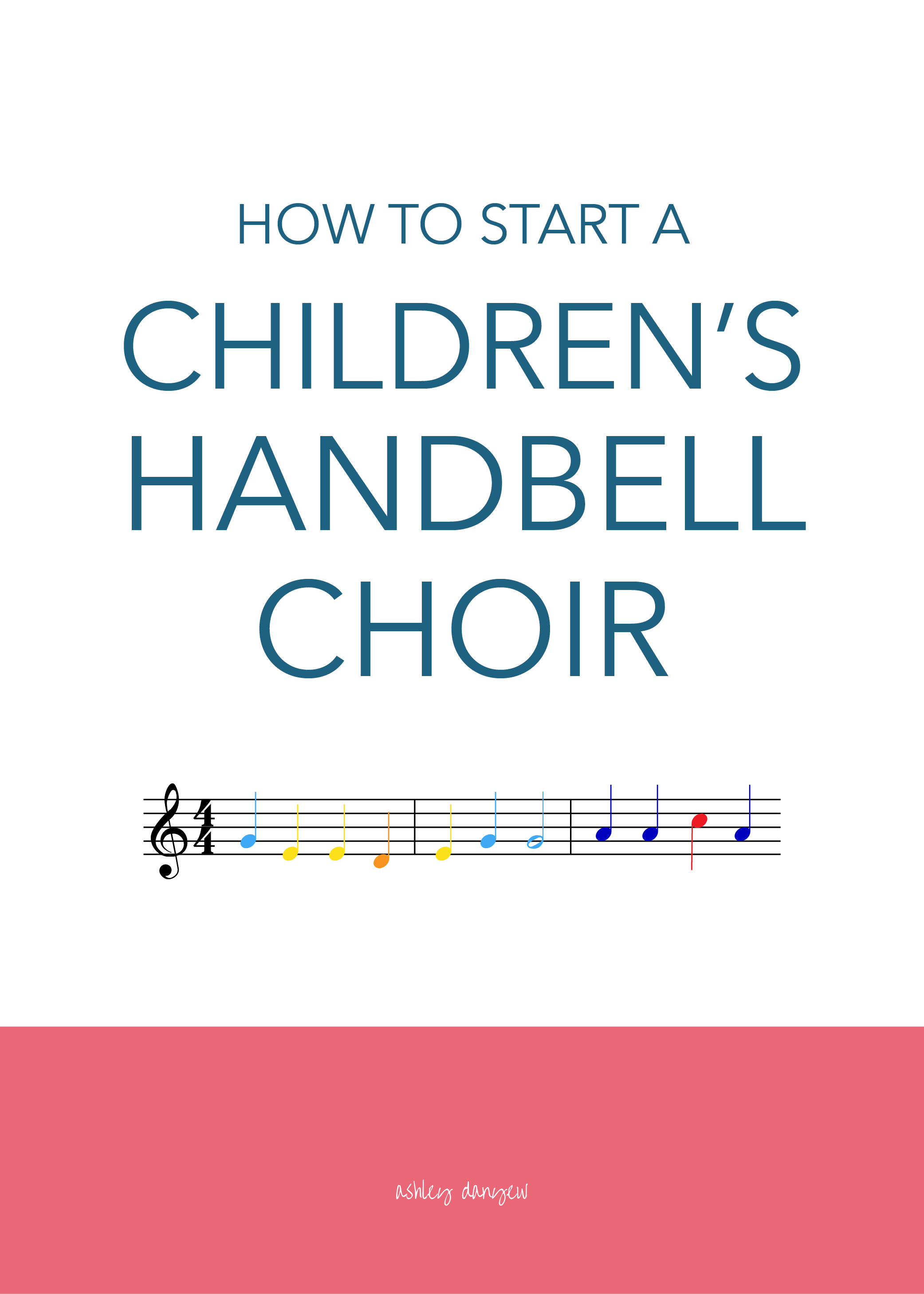
Playing handbells is a great way to foster the development of strong rhythmic skills, physical coordination, and listening skills. It's also an effective way to teach the basics of music-reading (direction, reading lines and spaces) and provide young children with an active way to play and make music together. Yes, young children! With color-coded metal handbells, children as young as preschool-age can play handbells.
Each bell/note is a different color and music notation is often color-coded to match. Some music features colored note values (e.g. red for Middle C). Others use colored letter names or a picture of the colored bell with the letter name inside.
Looking to start a children's handbell choir at your church? Here are some of my favorite products, resources, and teaching aids. Happy ringing!

Looking to dust off those handbells in the music closet and start a handbell choir this year? Great! First of all, check out this helpful resource from Reformed Worship - lots of practical information for getting started, recruiting, and choosing repertoire.
In today's post, I thought it might be helpful to share a round-up of free music resources. Yes, free!
These sites offer a variety of arrangements for bell choirs - some for a small number of bells, others for as many as 5 octaves, some with piano/organ accompaniment, others with instrumental parts. Whether you play them in worship or use them for extra reading practice in rehearsals, you can't beat free!

Ever since we started directing handbell choirs, we've struggled to find music that is accessible and appropriate for worship for small groups of ringers. Sure, there are plenty of beginning pieces (Levels 1 and 2), but much of the literature calls for 15 or more bells (2+ octaves), which is hard to manage with a group that has as few as six players (especially if they're beginners).
First, a quick word about collections: Over the past few years, we've come across a few collections that work great and pieces that are not only playable but also meaningful for all involved. Patricia Sanders Cota has written several arrangements for twelve bells (4-6 players), organized into various collections:
Twelve Bells for Worship (Vol. I and II)
Twelve Bells for Christmas (Vol. I, II, and III)
Twelve Bells for Praise and Worship (Vol. I and II)


Handbell choirs are a wonderful opportunity for community, creativity, and collaboration. And starting a new group is much less intimidating than you might think.
Whether you’re a church musician, a classroom teacher, or a community music director, you can bring people together to make beautiful music—even if they’re mostly beginners. The key is choosing flexible repertoire, using thoughtful teaching strategies, and creating a welcoming, supportive learning environment for all.