
093 - What We're Doing for Informances This Year

Resources Mentioned
*Disclosure: some of the links in this episode are affiliate links, which means if you decide to purchase through any of them, I will earn a small commission. This helps support the podcast and allows me to continue creating free content. Thank you for your support!
Ep. 069 - A Musical Informance to Celebrate the Solar Eclipse
Ep. 071 - 3 Things I Learned from Hosting a Musical Informance
Ep. 081 - Celebrating Women in Music: An Inside Look at Our Studio Informances
Essential Piano Technique, Level 2 (Penelope Roskell)
Piano Adventures, Level 3A (Faber)
Sakura - Secondo Part (arr. Faber)
Duet Music by Ann Buys
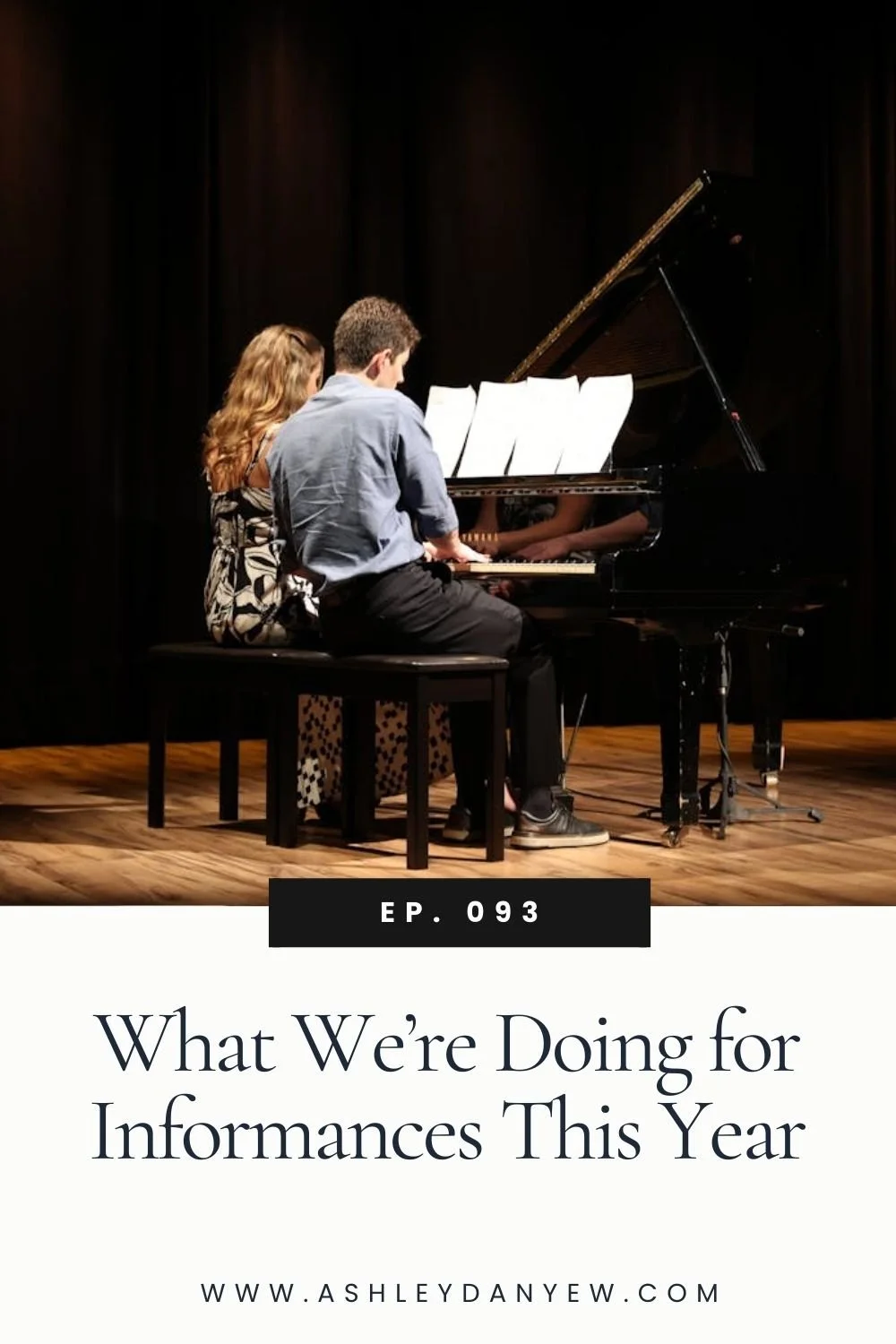
March in my studio means one thing: informance season. We spend 10 to 12 weeks getting ready—learning and analyzing music, practicing demonstrations, preparing to talk to the audience. And this year, I knew from the start that the theme was going to require a little more planning than usual.
If you’re new around here, I define a musical informance as an informal, informational performance that integrates education and experience. It’s an opportunity for students to share what and how they’re learning and invite parents and audience members into the music-making process.
I started hosting informances in my studio in 2024, so this is our third year. Each year, I choose a different theme and plan appropriate repertoire. I adapted the informance model from what I’d seen done in music education settings—elementary music classes and primary and secondary ensembles—for the independent music studio. I talk more about my process in:
Ep. 069 - A Musical Informance to Celebrate the Solar Eclipse
Ep. 071 - 3 Things I Learned from Hosting a Musical Informance
Ep. 081 - Celebrating Women in Music: An Inside Look at Our Studio Informances
Today, I’m sharing a behind-the-scenes look at our theme for this year, repertoire selections, and how we’re preparing for informances in the studio.
Choosing the Theme
I started working on informances just after the New Year, before lessons started back. I knew what I wanted the theme to be and that it would require a little more repertoire planning than in years past.
One weekday afternoon, I pulled out a stack of books and spread them out on the floor in the living room. I sat with my laptop, making notes, carrying books back and forth from the piano to play through things. After a few hours, my back needed a break, but I had a working list of informance repertoire to bring into lessons the following week.
Okay, are you ready to hear this year’s theme? It’s duets and ensemble music!
Why I Chose This Year’s Theme
Several of my students have played duets with friends—there are often one or two duets on our end-of-year recital—but I wanted to ensure that every student in my studio has the opportunity to play a duet or ensemble piece. And not just with me. I paired each student with a sibling, a peer, or an older or younger student in the studio to play a duet, trio, or quartet for this year’s informance events.
Logistics & Challenges
As you can imagine, this has been very fun to work on, but also posed a few challenges:
Assigning ensemble repertoire to the right students
Finding dates/times when those students are available to perform together
Coordinating rehearsals and shared lesson time for the month prior
Ensemble Assignments
I started with ensemble assignments—students I knew I wanted to pair together and thought could rehearse together during the week—then went in search of repertoire that fit their levels. Some students are friends and in the same grade, but play at two different levels. Others are siblings playing 1-2 levels apart. Two students are brand new to my studio, with one just starting in January. I also tried to assign the teacher part to older students where possible, so I looked for pieces in friendly keys.
Choosing Repertoire
Of course, there are a myriad of duet books out there, but I wanted to try to work with what I have and what my students already own, where possible. Generally, I try to avoid having families buy a new book if the student will only play one piece.
I ended up with a range of repertoire spanning several style periods: Classical, Romantic, and 20th century, plus two folk song arrangements, and some newer contemporary works by Amy Glennon, Ann Buys, and Aaron Burrows. The latter is a London-based pianist, composer, and teacher who wrote a fun piece called “Patchwork Polka” in Penelope Roskell's Essential Piano Technique, Level 2. It’s written for student and teacher, but can easily be turned into a duet by doubling up an octave. I decided to give this to my 4th-graders: I have one group of three and one group of four and they’ll take turns playing different lines together.
Rehearsal Schedule
With repertoire and ensemble assignments in hand, we spent the first 4-5 weeks of the semester working alone, learning notes and rhythms, reviewing technique, and sketching out initial interpretation ideas.
In mid-February, I started having students rehearse together. I don't have much extra time in my schedule to add 10- to 15-minute standalone rehearsal slots, so we've gotten creative. I emailed parents and explained who was paired with whom and when their lesson times were. I came up with two basic strategies:
Using one student’s lesson time or in some cases, alternating each week: Student A comes to the first 10 minutes of Student B’s lesson this week, Student B goes to the first 10 minutes of Student A’s lesson next week.
Taking advantage of back-to-back lessons, so one student comes a few minutes early and/or the other stays a few minutes late.
This works because I teach at a school. I can either pick up two or more students from their classrooms at the end of the day or from after-school activities, without requiring an extra trip for parents. There are only a few families driving in for a dedicated rehearsal, and even then, it's just three or four sessions total.
What Students Are Learning
Additional admin work aside, I’m already seeing the value of this theme. Students are learning about melody vs. accompaniment, balance, listening, breathing together, nonverbal cues, pedaling, musical contrasts, steadiness, musical styles, and more.
Here are a few glimpses of the conversations we’re having in lessons this month:
“Sakura” (arr. Faber)
Two 4th-graders are preparing the Faber arrangement of the Japanese folk song, “Sakura.” We’ve talked about how beautiful cherry blossoms are and how light and joyful spring feels, but the music is more reflective—a little melancholy, even. In our research, we learned that in Japanese culture, cherry blossoms symbolize beauty and mortality—the fragility of life. When I asked my students how they thought this was reflected in the mood of the music, one said, “I think it’s about cherishing something that went away, like Sakura. So you’re sad, but you still cherish it because you love it.”
One quick note about this piece: The Primo Part is in Piano Adventures, Level 3A. A Secondo Part is available on their website.
“Patchwork Polka” (Aaron Burrows)
As I mentioned earlier, I have 7 students learning “Patchwork Polka” in two groups. This one has been really fun to put together. We’ve been learning about the history of polka music—how it started in the 1800s in Bohemia (now the Czech Republic) and where that is on the globe. We listened to traditional examples with accordion, clarinet, trumpet, tuba, and drums, and talked about how polka became popular in other countries, such as Ireland, where string instruments were added.
Did you know that in Czech, the word půlka means “half” or “half step”? It refers to the quick, half-step movement in the dance. We learned a simple dance step, the Chicago Hop, which we’ll teach to the audience. We’ve also talked about why the composer chose the name “Patchwork” and how it relates to quilting.
One student shared, “In a quilt, there might be some things that aren’t the same, but similar, like these two lines.” Another pointed to the score and said, “This one sounds like fast polka dots.”
That gave me an idea. What if we created our own visual patchwork quilt with designs that represent the different lines of music? I cut out 4x4” squares from white chipboard and sent them home with students to design. I assigned each student two lines from the piece and asked them to create patterns or illustrations that represented the music. They came back with rainbows and checkered patterns, polka dots and swirls, in multicolor and monochrome. I’m going to piece them together on a display board to give the audience a visual map of the music and represent the diversity and shared culture of the polka.
“C Song” (Ann Buys)
Two sisters, 6th and 4th grades, are preparing Ann Buys’ “C Song.” This is the first time they’re playing a duet together. They describe the music as calm and a little sad, with one saying it reminded her of a starry night.
I was having trouble thinking about how else to interpret this piece, given its generic title. But on a walk a few weeks ago, I had an epiphany. Yes, the piece is in the key of C, and part of the melody outlines a C chord, but what else could “C” represent? I thought about our conversations and realized we’ve talked about several C words in learning this piece: collaboration, creativity, character, communication, counting, and connecting. After having the students discuss these things, we’ll turn to the audience and say, “As you listen, think about how you would finish this statement: ‘C is for ____.’”
This captures something true about informances in general—they're not just one-sided performances for an audience; they're an invitation into the music. Into the thinking, inquiry, and discovery.
What I keep coming back to is how much students are learning that goes beyond the notes on the page, especially breathing together, keeping track of another part while you play something different, and communicating without words. These are things you can only learn in ensemble, right? And I think that's the real gift of this theme: it’s about building musical relationships. Not just student to teacher, or student to audience, but student to student. I can't wait to see how it all comes together.
Musical Informance Planning Guide
A Resource for Piano Teachers
If you’re thinking about hosting an informance in your studio, I put together a 35-page PDF resource guide with eight theme ideas, leveled repertoire lists, source links, and ideas for related musical activities. You’ll also get a 12-week planning timeline + checklist (this is what I use in my studio), an activity-planning worksheet and materials/supply list, a sample program, and email swipe copy.

I’d love to hear from you:
Are you planning an informance in your studio this year? If so, I’d love to hear about it. Let me know what you’re working on and how your students are enjoying the process.







Earlier this year, I reread Cal Newport's Slow Productivity: The Lost Art of Accomplishment Without Burnout.
One of the things I really enjoy about Cal’s books is how well-researched they are. The three principles he outlines in this book are informed and enriched by writings, studies, and historical insights.
Cal addresses two main questions in this book: 1) How do we accomplish meaningful work without burnout? and 2) Can we take a slow approach to productivity?