
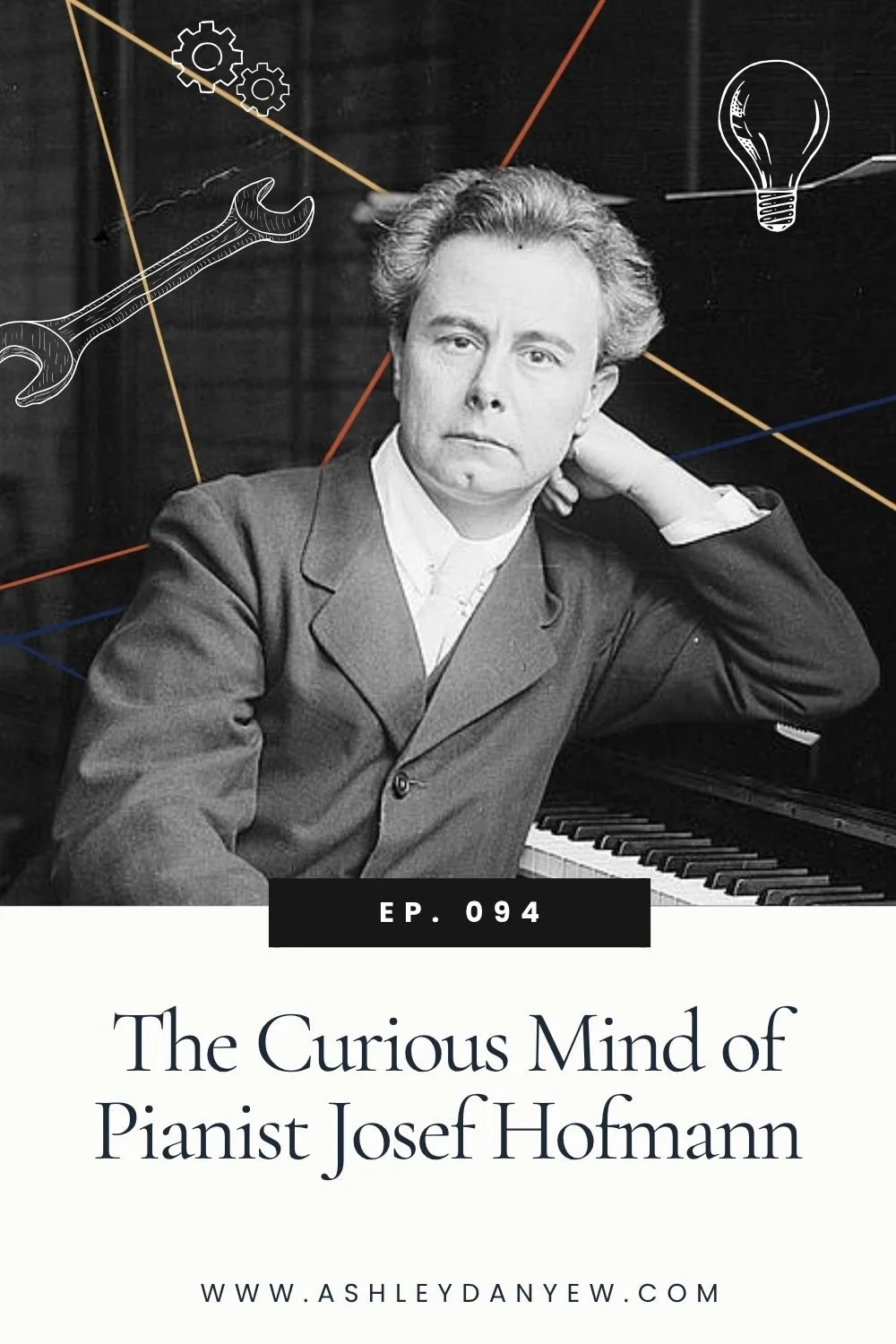
094 - The Curious Mind of Pianist Josef Hofmann
Resources Mentioned
*Disclosure: Some of the links in this episode are affiliate links, which means if you decide to purchase through any of them, I will earn a small commission. This helps support the podcast and allows me to continue creating free content. Thank you for your support!
Piano Playing, with Piano Questions Answered (Josef Hofmann)
Josef Hofmann (Mahler Foundation)
Josef Hofmann, the Pianist Inventor (Piano Street)
Josef Hofmann (Steinway & Sons)
Twice The Genius: The Music & Inventions of Józef Hofmann (Culture.pl)
Originals (Adam Grant)
Learn Faster, Perform Better (Molly Gebrian)
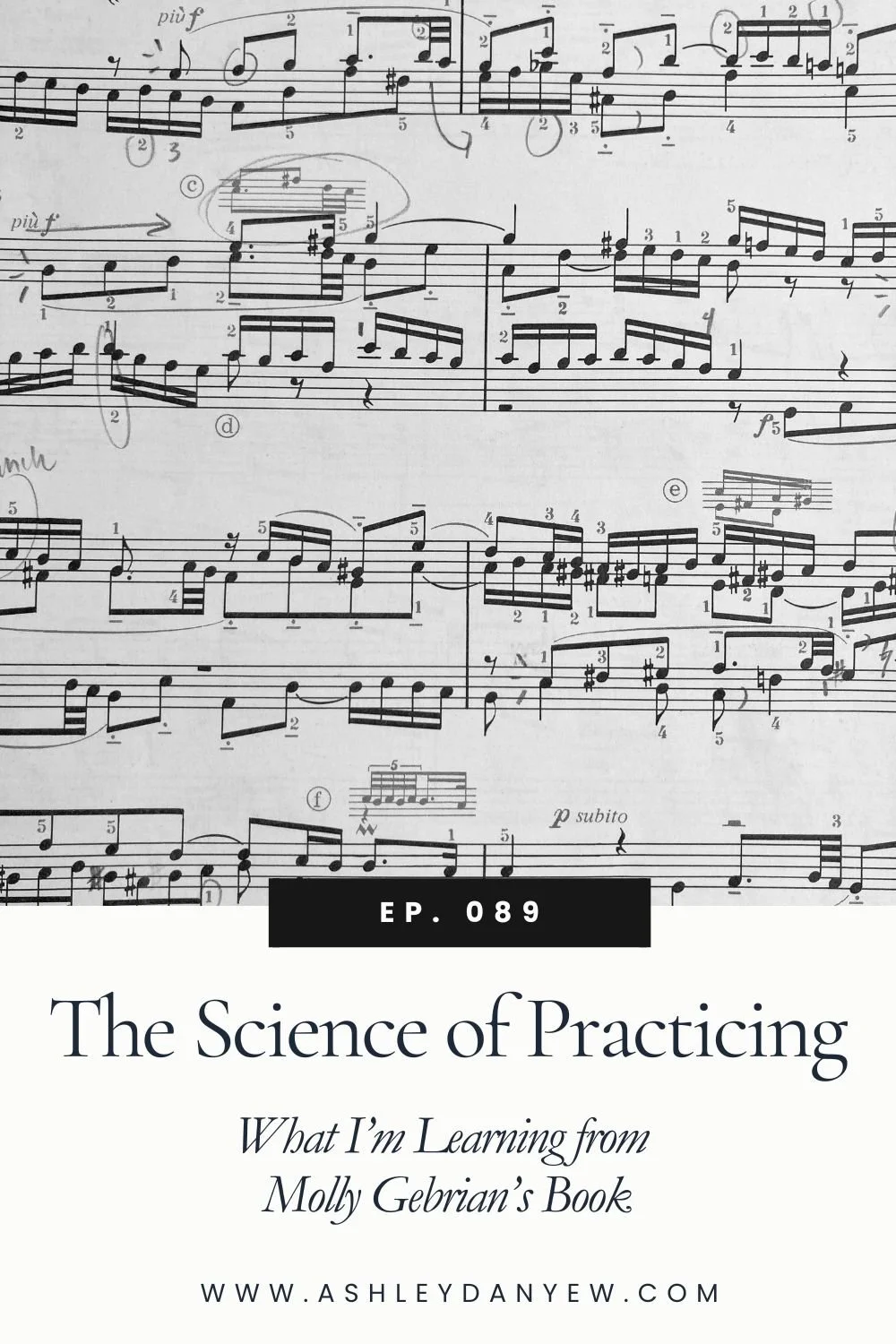
Ep. 089 - The Science of Practicing: What I’m Learning From Molly Gebrian’s Book
What does it look like to be a musician who is also an inventor—someone whose curiosity about how things work shapes the way he approaches his instrument? Pianist Josef Hofmann spent his entire career exploring that, and his story is worth knowing.
This year marks the 150th anniversary of Hofmann's birth. He was a Polish-American pianist, born in 1876, and considered by many—including Sergei Rachmaninoff—to be the greatest pianist of the 20th century. And yet, despite his many musical achievements, including a fifty-year performing career, 100 compositions, commercial recordings, a signature tone, and enviable technical precision, he doesn't have the same name recognition as his contemporaries.
What do we know about him? What set him apart? And what can we learn from him as musicians and teachers today, over a century later?
Today, I’m sharing some of my research into Hofmann’s life, career, and contributions to our field.
Hofmann as Musician
Piano Performance
Josef Hofmann was a child prodigy. He performed Beethoven’s C Minor Piano Concerto at the age of seven (the famous Russian pianist and composer Anton Rubinstein was in the audience). At nine, Hofmann set out on a European tour, with concerts in Germany, France, the Netherlands, Norway, Denmark, Sweden, and Great Britain.
At 12, an American tour was arranged with fifty recitals in three months at venues including the Metropolitan Opera House. The Society for the Prevention of Cruelty to Children stepped in to advocate for Hofmann’s fragile health and protect him from being exploited as a minor. A New York philanthropist and patron stepped in and paid the family a large sum with the condition that Hofmann would cease public performances until he turned 18 and receive a comprehensive education.
Hofmann studied with Anton Rubinstein for two years, from about the age of 16 to 18. He was Rubinstein’s only private student at that time. They had 42 lessons together, studying Bach preludes and fugues, Beethoven sonatas, and Rubinstein’s own music. Rumor has it he was never allowed to bring the same composition twice. Hofmann wrote about his studies with Rubinstein in his book, Piano Playing, with Piano Questions Answered.
On March 14, 1894, at the age of 18, Hofmann made his professional debut playing Rubinstein's Piano Concerto No. 4 in D minor, with Rubinstein conducting. That began a 50-year career as a performer and recording artist.
He emigrated to the U.S. during WWI and became a U.S. citizen in 1926. He headed the Piano Department at the Curtis Institute of Music from its inception in 1924 and was Director of the School from 1927 to 1938.
Composition
In addition to performing and teaching, Hofmann was an accomplished composer, writing over 100 pieces during his lifetime. Compositions range from a symphony, five piano concerti, and solo piano music, some published under the pseudonym Michel Dvorsky. (source: Mahler Foundation)
But Hofmann also had a life outside music that his contemporaries found puzzling—and, in some cases, telling.
Hofmann as Inventor
He was an inventor: a tinkerer, a builder of gadgets, a man fascinated by mechanics and how things work. By the end of his life, he had over 70 patents. These included a design for windshield wipers (inspired by the motion of the mechanical metronome), a new type of suspension in automobiles, a GPS, improvements to the recorded sound of the piano, piano-specific inventions such as pedal extensions and adjustable benches, and advances in piano action that Steinway later incorporated into their production. (source: Piano Street)
Steinway actually built custom piano keyboards for Hofmann with slightly narrower keys to accommodate his small hands. They write:
“His concert instruments had subtle action changes for faster repetition, and two pedals rather than three because he preferred the older Steinway trap work geometry. He was accompanied on tours by his own recital chair, built with a short folding back and an inch-and-a-half slope from rear to front.” (source: Steinway)
Not everyone, however, was impressed by Hofmann's technical proficiency. Some like Vladimir Horowitz acknowledged that, though Hofmann was "a very good pianist,” he was a “second-rate musician,” perhaps due to his focus on technical precision vs. other aspects of musicianship, such as artistic expression.
Arthur Rubinstein also commented that Hofmann didn’t seem all that interested in discussing music when they met, but was eager to show off his recent gadgets and talk about invention (source: Culture.pl).
His interest in mechanics and how things work is interesting because this shows up in his approach to piano-playing and musical interpretation, as well.
This reminds me of Leonardo da Vinci: Most people know him as an artist—a painter and sculptor—but he was also interested in architecture and music, math and engineering, geology and cartography, and anatomy and botany. In his book, Originals, Adam Grant shares insights from historian William Pannapacker:
“Leonardo’s studies of how light strikes a sphere, for example, enable the continuous modeling of the ‘Mona Lisa’ and ‘St. John the Baptist.’ His work in optics might have delayed a project, but his final achievements in painting depended on the experiments. . . . Far from being a distraction—like many of his contemporaries thought—they represent a lifetime of productive brainstorming, a private working out of the ideas on which his more public work depended.”
Leonardo da Vinci called it “connecting the unconnected.” By comparing two completely unrelated subjects, such as engineering and anatomy, or astronomy and music, and identifying what they had in common, he learned that the human brain naturally builds connections between disparate inputs. In other words, if you focus on two ideas or topics for long enough, you will begin to see a relationship between them.
I think this was probably true for Josef Hofmann, as well.
What I find inspiring about both da Vinci and Hofmann is that their outside interests deepened and enriched their primary work. Hofmann never separated his curiosity about mechanics and how things work from his approach to the piano. And that shows up clearly in his writing about practice.
Four Ways to Practice
Mid-career, he wrote three books on piano playing. I mentioned one at the beginning—published in 1914. The first two, also about piano playing, were published in 1907 and 1909.
Practicing has been on my mind recently as we prepare for our year-end recital. I’m trying to help my students (and their parents) learn better and more productive ways to practice at home during the week. As such, I was interested to read Hofmann’s description in his 1914 book on four ways to practice a piece of music:
The first is playing the piece at the piano reading the score carefully.
The second is playing your piece at the piano without the score (from memory).
The third is to study the score away from the piano, hearing the music without any sound being present (audiating).
And the fourth is to sit away from the piano, close your eyes, and visualize your hands playing the piece on the keyboard.
In these last two approaches, Hofmann emphasizes the importance of mental practice. This also came up in Molly Gebrian’s book, Learn Faster, Perform Better, which I talked about in Ep. 089. If you’re looking for more scientific practicing insights, it’s worth going back to that episode.
Hofmann also advocated for shorter, more focused practice sessions rather than longer sessions, which often lead to less-engaged playing and mechanical repetition. This sounds like advice I’ve been giving my students lately, especially my middle and high schoolers!
Recordings
Hofmann made a few commercial recordings in the early 20th century, and I’ve been reviewing some of them, particularly his live performance of Chopin’s Berceuse from 1938 and his spirited interpretation of Beethoven’s Waldstein Sonata from the same year. The technical clarity and lightness in both pieces are impressive and captivating. And do you hear that singing left hand in the Beethoven?
I’ll also add that historical recordings like these are worth bringing into your studio, too. This could be a great listening project for intermediate students: Discussing interpretation, musical expression, tempo, and technical choices helps students develop their musical vocabulary, awareness, and understanding.
Summary
Josef Hofmann is a good reminder that the musicians we tend to look to as examples were rarely one-dimensional. He was a performer and a tinkerer, a composer and an inventor, a teacher and a writer. Broadening his interests and finding points of connection between them made him only more exceptional.
As musicians, I think many of us feel pressure to stay narrowly focused—to pursue one thing, primarily. But your curiosity about other subjects, other disciplines, other ways of solving problems, might be exactly what makes you a more perceptive teacher.
I’d love to hear from you:
What's something that captures your attention outside of music? What do you research and learn about on your own time? Pay attention to it. You might be surprised how it informs, inspires, and shapes your musical work.








It started with an aspiration: “I want to get back into regular practicing,” I said to Steve one day. “But without a performance commitment, it’s hard to justify the time. What’s the point?” “There doesn’t need to be a point,” he said simply. “Do it for you. I think you’d enjoy it.”
In that moment, I gave myself permission to start: A recommitment, a new routine, an artistic practice.