
096 - How I Use Assessment in My Studio
Resources Mentioned
Assessment is a process of measuring, evaluating, and documenting learning.
Measuring a student’s progress in the studio provides an opportunity for reflection, evaluation, and deeper understanding as we consider with our students what they know and can explain or demonstrate.
This informs our teaching, curriculum planning, and repertoire choices. In turn, it also helps students develop a diverse set of musicianship skills, including technique, performance, aural skills, sight-reading, and musical creativity.
There are two main types of assessments: formative and summative.
Formative assessments are usually quick, informal strategies you use throughout the year to measure learning and skill development as it’s occurring. This may include solo playing, personal evaluations (written, spoken, or communicated gesturally), learning a piece by ear, or improvising. These activities provide valuable information to you as the teacher, which can help you design future learning experiences.
Summative assessments are more formal, in-depth ways of measuring a student’s growth and learning at the end of a semester, term, or year. This may include end-of-year performances, competitions, or juries that use a rating scale or rubric for scoring, graded theory tests, or paper-and-pencil worksheets.
If you’re a pre-college studio teacher, you may not use summative assessments that much—we don’t usually assign grades at the end of the term, and though a written reflection may be sent to parents, a formal report card with various criteria is not generally used.
How do you ensure that your students are developing comprehensive musicianship skills? How do you measure this throughout the year?
In this episode, we’ll talk about how to plan an assessment for your studio, including defining assessment criteria and choosing measurement tools, and how to use this data to motivate your students and inform your teaching.
Part 1: Planning an Assessment
Assessment is a vital component of the music teaching and learning process. The challenge for most teachers is time.
It can be difficult to get through all of a student’s assigned repertoire, technical routines, and sight-reading each week, let alone make time for aural skills, music history or theory, listening, and creative activities like improvising or composing.
Assessment doesn’t have to be an additional thing you add to lessons. It doesn’t have to take up any extra time—it can fit into what you’re already doing. All you need is a clear understanding of what you’re evaluating and an objective way to measure it.
Let’s talk first about defining assessment criteria. What do you want your students to know and be able to demonstrate? This may include:
Technique (including articulation)
Sight-reading (tonal and rhythm)
Sense of steady beat
Musical expression (including balance, phrasing, and dynamics)
Understanding of harmony
Performance
Pattern recognition (or at an earlier level, same vs. different)
Critical listening
Musical creativity (composing and improvising)
Aural skills (including intervals and tonal and rhythm recall)
I try to evaluate most of these things through informal assessments. Any time we do an improvisation activity in lessons or pick out a song by ear, I’m observing how my students explore and learn, what patterns they recognize and integrate, and how much they’re able to do independently.
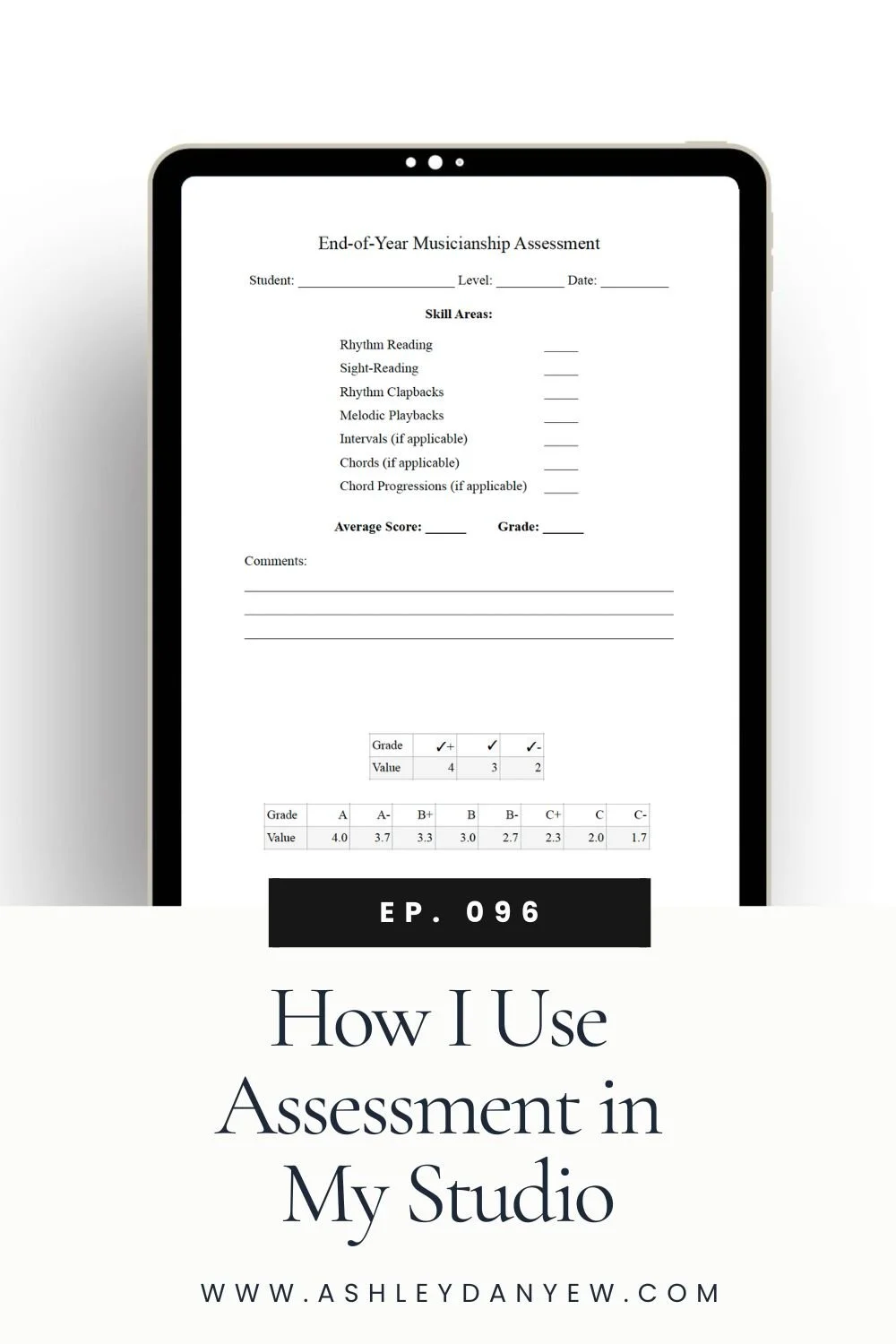
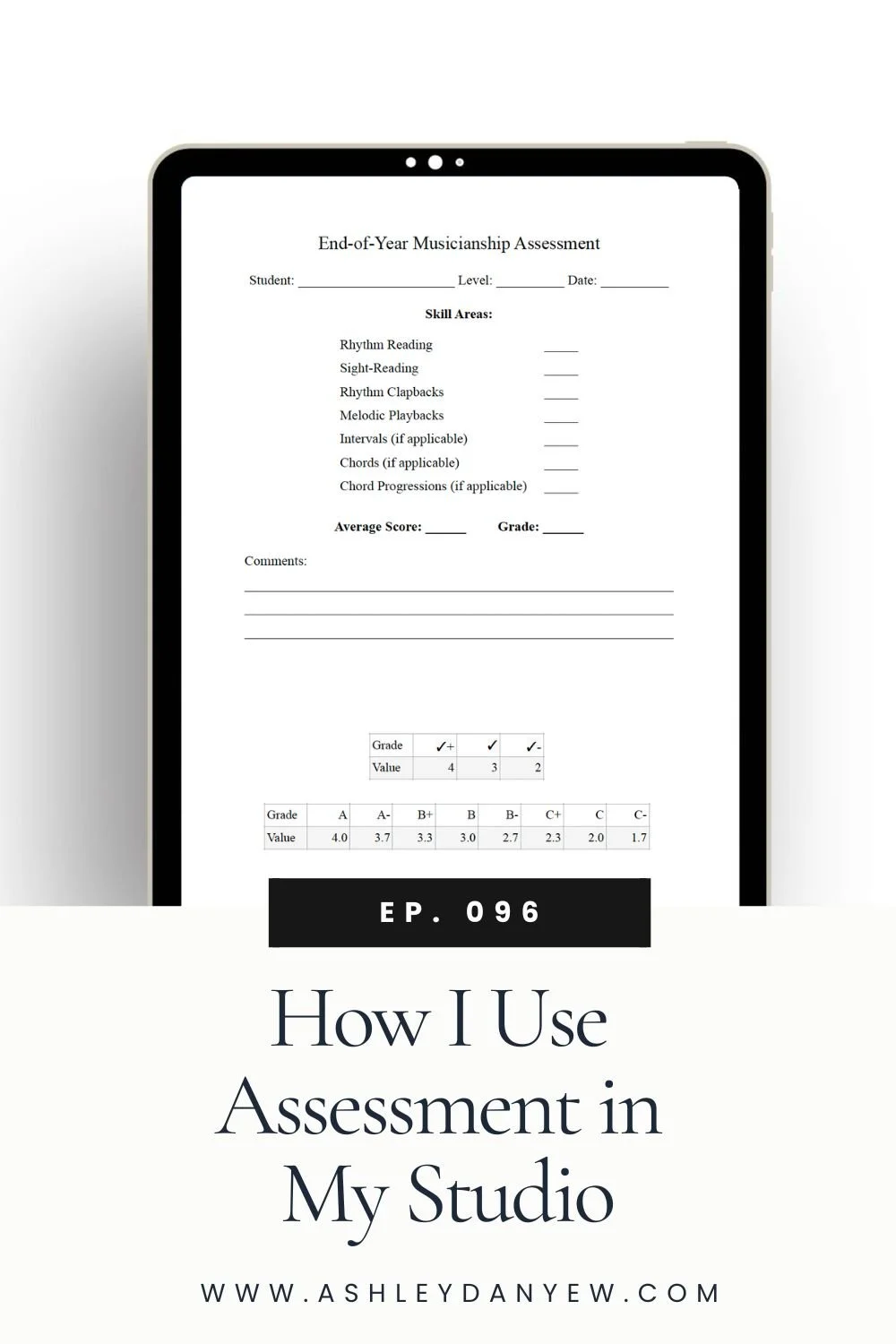
I’ve found that one summative assessment each year helps me objectively track musical growth and skill development in my students. At our last lesson of the school year, the week after our Spring recital, we spend about 15 minutes doing assessments.
I look at three categories of musicianship:
Rhythm
Sight-reading
Aural skills
Most of my students enjoy this—it’s like playing ear-training games.
I use the RCM Piano Syllabus as a guide. Several years ago, I developed a handbook of exercises for each RCM level (Preparatory A through Level 8) that I reference each year to ensure my students are developing musicianship skills that correlate with their repertoire level (or in some cases, a level beyond).
I use a simple check-plus, check, and check-minus system:
✓+: The student completes the activity with no issues.
✓: The student makes a mistake or two, but overall, they demonstrate the skills they need to meet the challenge.
✓-: The activity is too challenging. The student makes several mistakes or struggles to get through it.
During my post-assessment reflection, I look for mostly checks and check-pluses. A check-minus indicates an area where something is not clear or a skill is still developing. This shows me where there’s an opportunity for growth, and where we can spend more time in the future.
After planning what you want to evaluate and measure, you’ll need to choose your assessment tool or tools.
Part 2: Choosing Assessment Tools and Collecting Data
There are two primary methods of conducting research: quantitative and qualitative.
Quantitative ResearchQuantitative research focuses on numbers and things that can be measured objectively. It answers the questions “what” and “how much”.
Rating scale: This tool helps you reliably measure specific skills or elements of a performance. Create a checklist of skills and assign each a point value. For instance, under Technique, you might include hand shape, fingering, characteristic tone, tonal accuracy, and rhythm accuracy. Observe a student’s performance and use the rating scale to evaluate their musical skills and development. Tally the points and assign an overall grade or score.
Rubric: A rubric is a set of rules that define expectations for music learning or performance. It’s a grid that lists the specific criteria down the side (what’s being measured) and performance levels across the top (ranging from fair to excellent). What’s helpful about this tool is that each level is clearly described, which makes it easier to see where a student is. For instance, for Technique:
Fair: Many wrong notes, insecure knowledge of keys and patterns, inconsistent tempo, frequent stumbles, inconsistent touch
Acceptable: Fair knowledge of keys and patterns, but there may be several wrong notes, slow tempo, uneven tone quality
Good: Keys and patterns are well known, played at or above minimum tempo, there may be a small number of minor slips or stumbles, good tone quality and sense of direction
Excellent: Flawless performance of all requested elements, secure knowledge of keys and patterns, performed with exceptional fluency at or above minimum tempo, singing tone quality and a sense of musical shape and direction
You can assign each of these levels a number of points like 1, 2, 3, and 4, then tally up the number of points across criteria to get a total score.
Qualitative ResearchQualitative research focuses on the participant’s experience, using words, audio, video, and observations to explore and find meaning. It answers the questions “why” and “how”.
Recordings: Audio and video capture the moment—sound, tone of voice, pauses, inflection, musicality, gestures, nonverbal communication, and more.
Written observations: These are your field notes, either written in the moment or in reflection soon after. What do you see and hear? Where does the student seem most confident? Where do they seem insecure, and what makes you think this? Try to reconstruct the experience as objectively as possible, acknowledging your bias.
Student self-assessments: Having students share their own reflections and self-evaluations adds another dimension and unique perspective to the data you’re collecting.
You’re probably doing informal qualitative research in almost every lesson. You’re studying sound and gestures, musical expression and technique. You’re evaluating a student’s skill, understanding, and confidence.
Once you’ve collected data for each student, whether through one summative assessment or several formative ones, the final step is analyzing it and applying what you’ve learned.
Part 3: Analyzing the Data and Applying What You’ve Learned
If you have quantitative data—a rating scale, rubric, or graded test—this is more objective and easier to analyze. Simply tally the numbers to get an overall score, then convert it to a percentage of 100. For instance, if you have a 20-point rating scale and a student scored 17, their score would be 85 out of 100. This makes it easier to assign a letter grade, whether you’re sharing that with students or parents or just keeping it for your own records.
For qualitative data, the process can be more complex, but since you’re not writing a dissertation, here’s a simplified process:
Review recordings and take notes on what you see and hear. You could also have your student do the same, then compare.
Review written materials (your notes, assignment sheets, and any student reflections) and make note of themes. What topics, ideas, or patterns come up consistently?
For instance, if a student says, “I don’t know” or “I’m not sure,” that could be categorized as “Uncertainty.” Comments or directions from you could be categorized as “Teacher Influence.” If a student describes their practicing process or identifies a problem spot, it could be categorized as “Practicing Approach” or “Learning Process.”
Make a list of all the themes you identified and combine ones that are related. What 4-6 key themes emerge?
Again, qualitative methods are not about assigning a letter grade or score, but reconstructing the experience and exploring what makes it meaningful or significant. Of course, you can also use a combination of research methods and analyze both at the end of the year to give you a better understanding of what a student has learned and experienced.
Once you’ve analyzed the data, you can decide whether or not to share this with your students and their parents in a report card format or whether it’s just for you. I tend to keep the data to myself. I use it to inform my curriculum planning, repertoire selection, studio classes, and lesson activities. Mostly, I find it’s a way to document the teaching and learning process and ensure that students are developing comprehensive musicianship skills.
Conclusion
Assessment should always come full circle and inform future learning experiences. I hope this inspires you to build more assessments into your teaching and gives you a few new tools to use with your students. I’d love to hear about your experience—do you do any kind of assessment (formal or informal) in your studio? Have you used any of the tools I shared in this episode? Let me know in the comments.








Earlier this year, I reread Cal Newport's Slow Productivity: The Lost Art of Accomplishment Without Burnout.
One of the things I really enjoy about Cal’s books is how well-researched they are. The three principles he outlines in this book are informed and enriched by writings, studies, and historical insights.
Cal addresses two main questions in this book: 1) How do we accomplish meaningful work without burnout? and 2) Can we take a slow approach to productivity?